Tokyo Water Taxi charges by the boat rather than by the seat, and that single fact decides whether it makes sense for you.
The meter runs at ¥5,000 per 15 minutes on the water, plus ¥1,000 per 15 minutes to bring the boat from its Shibaura base to your pier and back again.
The operator’s own headline example is Shinagawa to Odaiba in 15 minutes for ¥7,000 per boat, which is ¥875 each with eight aboard and ¥3,500 each for a couple.
Nothing here is a scheduled service.
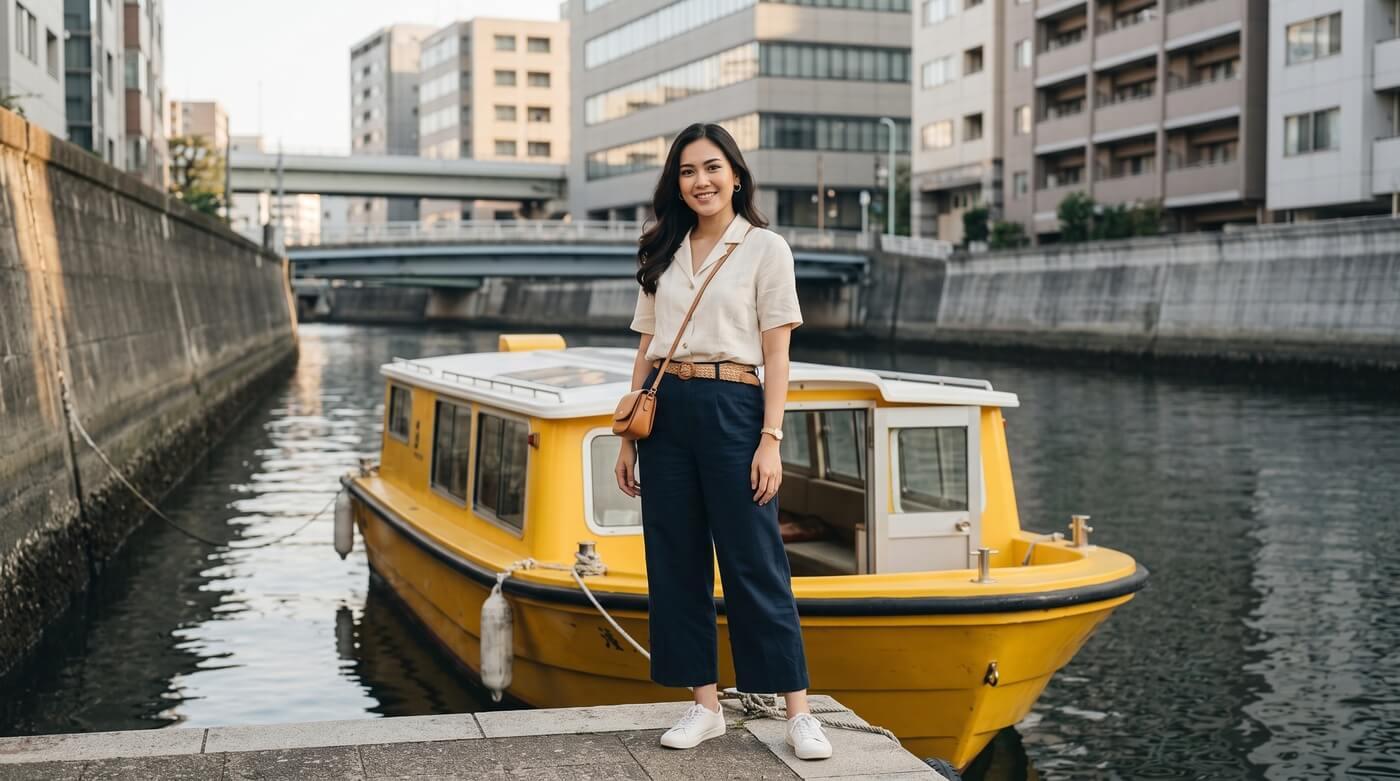
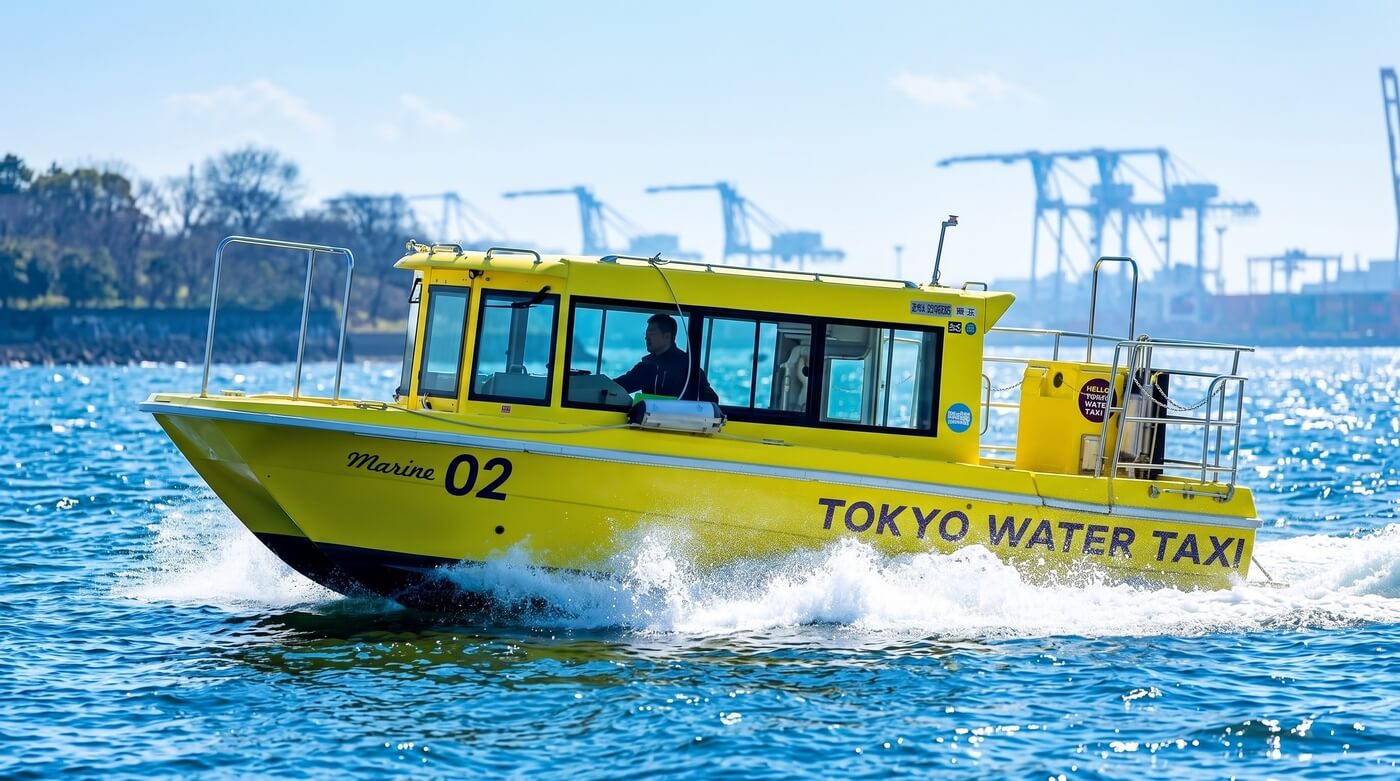
Every ride is a pre-booked private charter on one of five catamarans, Marine02 through Marine06, each 7.41 metres long and licensed for eight passengers, with an air-conditioned cabin, a toilet, four power outlets, a Bluetooth speaker, and an open rear deck.
The hulls were built for this job: low enough to clear bridges at high tide, shallow enough to avoid grounding at low tide, and short enough to turn inside the Shibaura and Shinagawa canals that the big restaurant ships cannot enter.
You bring your own food and drink, alcohol included, and two medium dogs ride free.
Departures run from 11:00 with every boat back by 20:00, and the company closes on Mondays, shifting the closure to Tuesday when Monday is a public holiday.
Web bookings for the fixed Basic Ride routes close at 12:00 on the day of travel and open only two months ahead.
Stepping off after 17:00 adds a 20 percent night surcharge to the running and repositioning fees combined, which is worth knowing before you book the sunset slot everyone wants.
Checked on 7 September 2026, the operator was running normally and had just added BLUE FRONT SHIBAURA to its pier list.
Tokyo Water Taxi charges by the boat, not by the seat, which is the fact that decides whether you should book it. Fifteen minutes from Shinagawa to Odaiba costs ¥7,000 for the whole boat, so ¥875 each with eight aboard and ¥3,500 each for a couple. Every ride is a pre-booked private charter on an eight-seat catamaran, and the company does not sail on Mondays.
Tokyo Water Taxi is a private charter service, not public transport, and the whole pricing model follows from that. Before you book, these are the numbers and rules that decide whether it makes sense for your group.
Tokyo Water Taxi: What a Private Yellow Boat Really Costs
Checked on 7 September 2026 for this Tokyo Trip Guide entry, Tokyo Water Taxi is operating normally, taking bookings from 11:00 with every boat back at a pier by 20:00.
The cheapest published ride is 15 minutes from Shinagawa to Odaiba at ¥7,000 for the whole boat.
Nothing runs to a timetable, nothing can be flagged down from a jetty, and nothing sails on a Monday.
TL;DR
Hide
Status: Operating, verified 7 September 2026
Cheapest ride: ¥7,000 per boat, Shinagawa to Odaiba in 15 minutes
Running rate: ¥5,000 per 15 minutes, dropping to ¥4,000 per 15 minutes after the first hour
Boat: Marine02 to Marine06, 7.41 metre catamarans, eight passengers
Closed: Mondays, plus 31 December to 3 January
Tokyo Water Taxi charges by the boat, not by the seat: ¥5,000 per 15 minutes on the water, dropping to ¥4,000 per 15 minutes once you pass the first hour.
The cheapest published ride is ¥7,000 for the whole boat, Shinagawa to Odaiba in 15 minutes, which comes to ¥875 each with eight people aboard and ¥3,500 each for a couple.
A repositioning fee of ¥1,000 per 15 minutes each way, measured from the Shibaura base, is the line item most people fail to budget for.
Every ride is a pre-booked private charter. Web bookings close at 12:00 on the day of travel, and reservations open only two months ahead.
Stepping off after 17:00 adds a 20 percent night surcharge, so a golden-hour ride in late December can finish before the surcharge starts while a June sunset ride cannot.
The company closes on Mondays, shifts that closure to Tuesday when Monday is a public holiday, and shuts entirely from 31 December to 3 January.
Boats sail in rain light enough to walk through under an umbrella, the operator confirms by around 18:00 the day before, and weather cancellations cost nothing.
Trip Essentials
Tokyo Travel Add-ons
Equip yourself for the ultimate Tokyo adventure with the following add-ons, curated just for you.
Tokyo Water Taxi is worth booking once there are four of you, or when you have a reason to be on a private boat that no other Tokyo operator can meet.
Split four ways, the ¥7,000 Shinagawa to Odaiba hop works out at ¥1,750 each, which is roughly what the same four people would pay a road taxi for a similar distance across Minato.
Split two ways it is ¥3,500 each for a quarter of an hour, and at that point you are paying for novelty rather than transport.
The reasons that override the arithmetic are specific.
Two medium dogs ride free on the standard booking, which no other Tokyo cruise operator allows.
Up to four bicycles travel on the rear deck, e-bikes excluded.
You can carry your own food and drink aboard, alcohol included, and there is a folding table and a Bluetooth speaker to go with it.
If any of that describes your day, the charter fee stops being the point.
One line item catches almost everyone.
The running fee is only part of the bill, because the operator also charges ¥1,000 per 15 minutes each way to bring the boat from its Shibaura base to your chosen pier and take it home again.
Two piers that look adjacent on a map can sit half an hour apart by water, and you see the real total only at the booking screen.
The operator’s own worked example, leaving Shibaura at 16:30 and landing at Odaiba at 17:45, comes to ¥32,000 for 75 minutes once the return repositioning, the night surcharge, and the ¥2,000 Custom Ride adjustment fee are added.
Sixty Minutes Through the Shibaura Canals
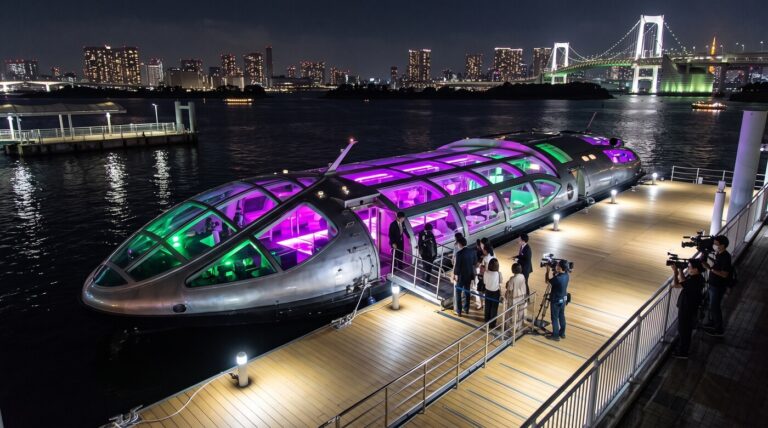
Tokyo Water Taxi Marine 02
A Tokyo Water Taxi ride starts in a canal rather than on the bay, and the first ten minutes are the part nobody photographs.
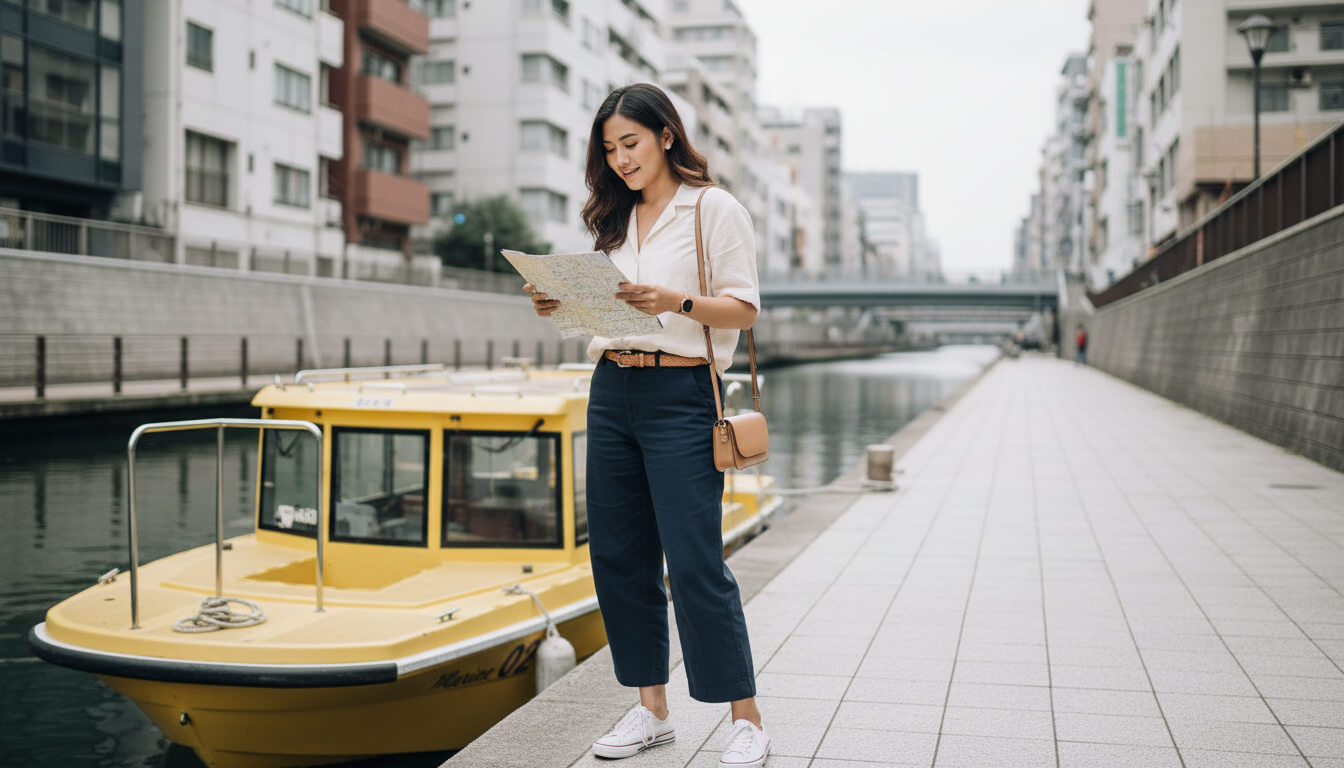
You board at a concrete landing, often below a road bridge, ten minutes before your slot.
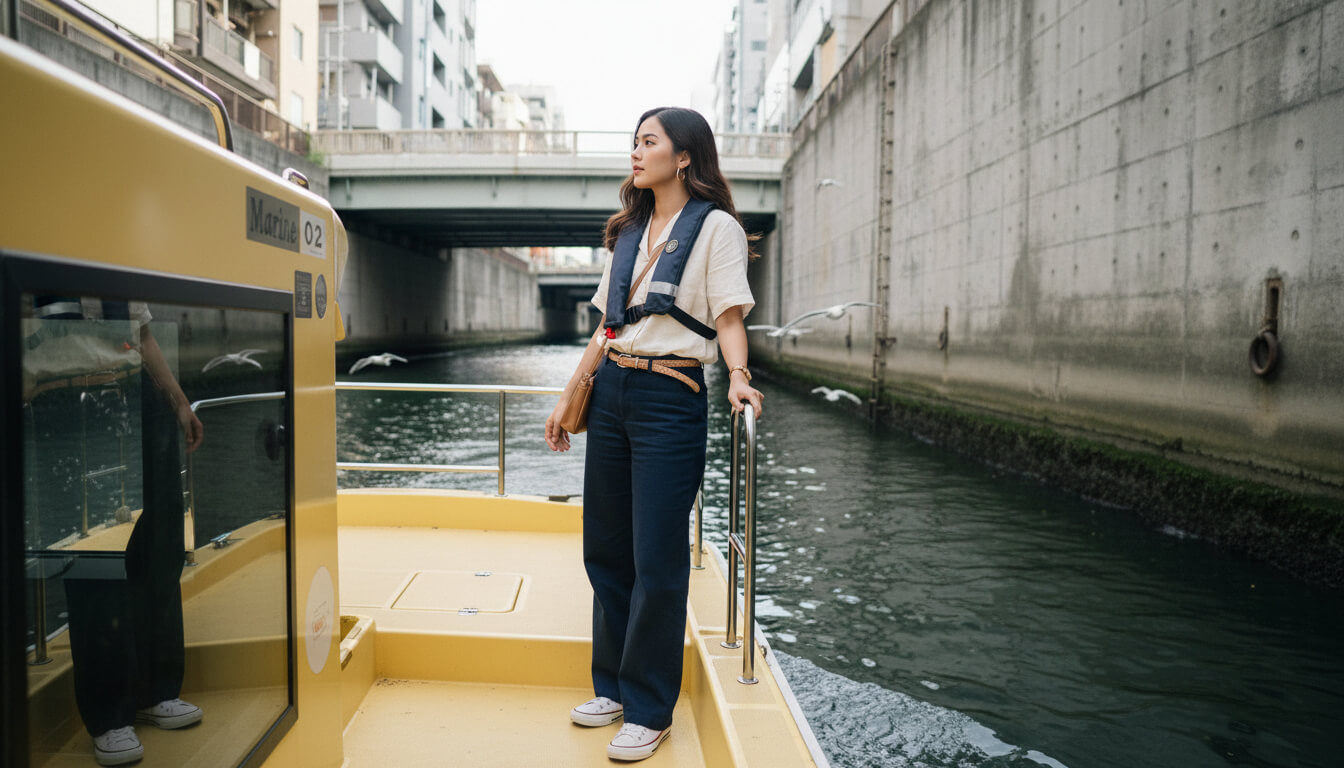
The captain hands out life jackets, runs a short safety brief, and then the boat noses out between canal walls close enough that you can read the tide marks on the concrete.
Those walls are the reason the hull looks the way it does.
The Marine boats were built to this operator’s own design, low enough to pass under bridges at high tide, shallow enough not to ground at low tide, and short enough at 7.41 metres to turn around inside a channel where a restaurant ship would have to reverse for a kilometre.
Gulls work these canals in numbers, particularly around Shinagawa, and they follow the boat for a while.
Then the water opens.
Coming out of the Shibaura and Shinagawa channels into the Sumida River mouth, the first landmark that registers is Hama-rikyu Gardens on the left bank, its pines low against the water, with the 333 metre lattice of Tokyo Tower standing behind the trees.
That layering, garden in front and tower behind, only exists from the water.
From the promenade you get one or the other.
South of there the boat runs for Rainbow Bridge.
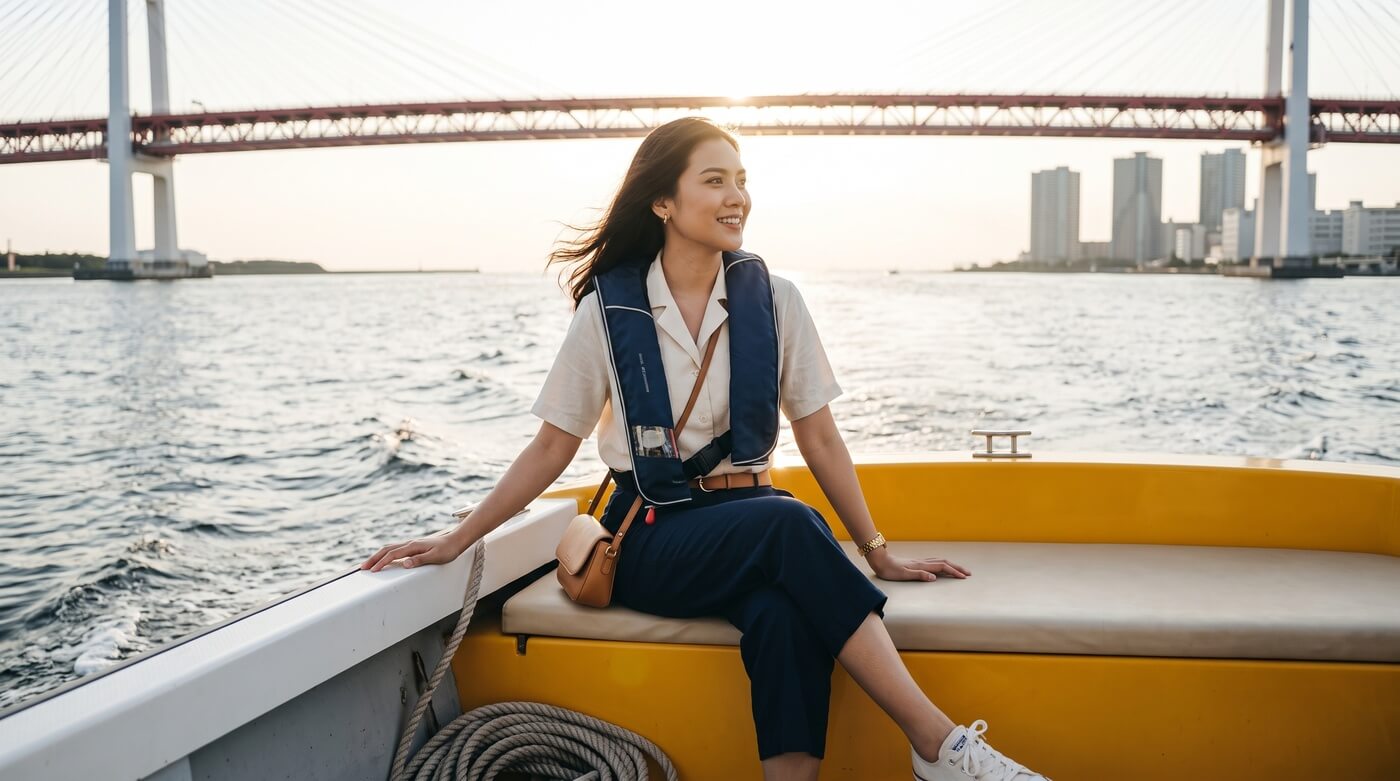
Passing underneath is the moment everyone stands up for, and the photograph people actually keep is taken from the open rear deck as the last canal bridge clears and the span fills the frame ahead.
You need a life jacket to be out there, which the crew will hand you without being asked.
Which side to sit on is the wrong question on a boat this size.
Two thirds of the passenger space is an air-conditioned cabin with a toilet, four power sockets, and cup holders; the other third is open deck, and the deck is where the trip happens.
Everyone rotates through it.
In February the cabin is genuinely warm, and in August it is the only comfortable place on Tokyo Bay.
Past the bridge the scenery turns industrial, and that surprises people who booked expecting skyline.
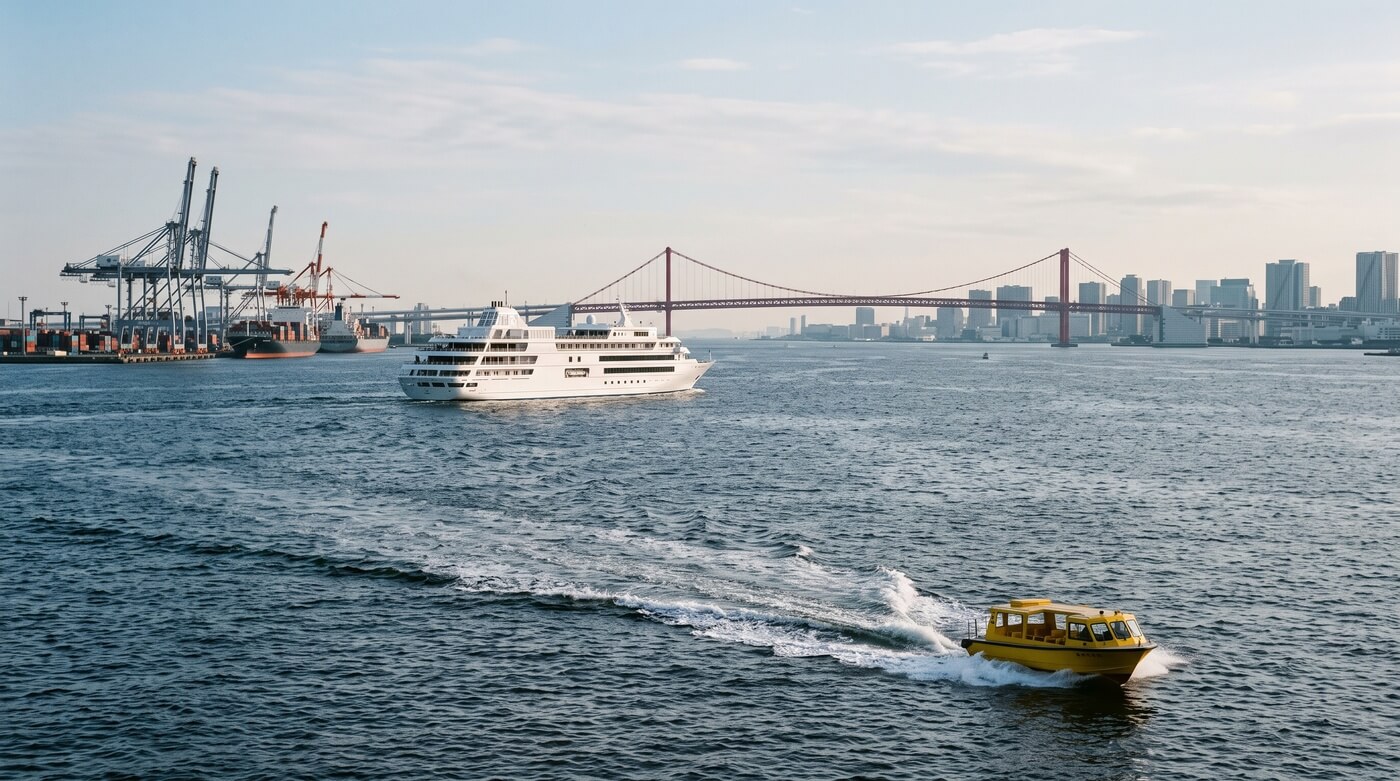
Container ships up to 300 metres long sit at the wharves, gantry cranes stand in rows with their booms raised, and pilot boats and tugs cross in front of you.
The operator treats this as the point rather than an inconvenience, and after twenty minutes of it you start to see why.
The sound is the other thing that separates this from a big boat.
There is no public address system and no recorded commentary.
The captain talks to eight people over a diesel note that stays low at canal speeds, so you can hold a conversation, and if you would rather not, you connect your phone to the speaker.
English on board varies by crew, which is the honest caveat: one traveller in June 2026 rated the boat and the route highly and still reported that the captain and guide struggled to communicate.
Most bay loops finish at Tennozu Pier, five minutes from Tennozu Isle Station on the Tokyo Monorail and the Rinkai Line, which is a better place to be dropped than where you started.
Basic Tokyo Water Taxi Ride Versus Custom Ride
Book Basic Ride the first time.
It is the web-booking route where you pick a departure pier, an arrival pier, and a time, and the system works out the running fee, the repositioning fee, and any night surcharge before you pay, so you see the real number rather than a quote by email.
Payment is card only and in advance, and the booking window closes at 12:00 on the day of travel, after which you have to phone 03-6673-2528 and take whichever piers are still free.
Custom Ride exists for the trips Basic Ride cannot express.
A concierge builds the route with you by email or phone, there is no fixed itinerary, and you can pay on the day by IC card, e-money, or a barcode app instead of prepaying.
That flexibility costs a flat ¥2,000 adjustment fee per sailing.
It is also the only way to bring more than two dogs, to bring a large dog, or to book the tuna bowl live-through, which is exactly what it sounds like and is not available on the web system.
Two booking mechanics are worth knowing early.
Reservations open only two months ahead, so there is no point planning a specific date a year out.
And luggage counts against the eight-person limit: a cabin-size suitcase takes one place and a large one takes two, which means six adults with checked bags will not fit on a single boat.
Book the Tokyo Water Taxi Winter Sunset Not the Summer One
Stepping off after 17:00 adds a 20 percent night surcharge to the running and repositioning fees combined, which makes the timing of Tokyo’s sunset a pricing question rather than a preference.
Tokyo sunset falls near 16:30 in late December, so a golden-hour ride in winter can be back alongside before the surcharge starts.
In June the sun sets close to 19:00 and the entire ride is charged at 120 percent.
Rain matters less than you would expect.
Tokyo Water Taxi sails whenever the rain is light enough to walk through under an umbrella, and with the cabin enclosed and heated it is a reasonable wet-weather booking.
Every departure is judged against the operator’s safety rules and the answer reaches you by around 18:00 the day before, so you get a night’s notice either way.
If the company cancels for weather you pay nothing.
If you cancel, it costs 30 percent three days out, 50 percent one to two days out, and the full fare on the day.
In 2026 the cherry blossom charters ran from 14 March to 12 April, with the company dropping its usual Monday closure for the season, and a 75 minute round trip from Tennozu along the pink corridor of the Meguro River sold at ¥40,000 per boat.
A shorter 30 minute loop from Gotanda River Station ran at ¥30,000 between 29 March and 2 April only.
Confirm the current year’s dates before you build a trip around them, because they are republished each February and bookings open with them.
Cheaper Boats That Do a Different Job
For one or two people who simply want to be on the water, Tokyo Water Taxi is the wrong purchase.
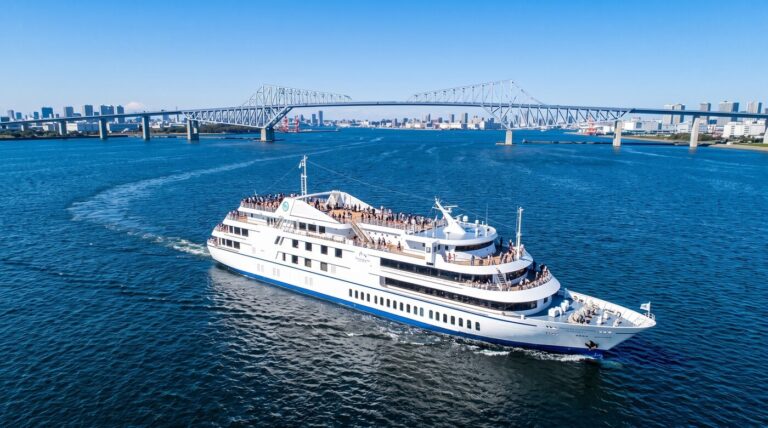
For a couple who want a proper cruise with a big deck and a course menu, the Symphony ships out of Hinode Pier sell a boarding-only ticket at ¥1,800 for an adult and ¥900 for a child on the 50 minute afternoon sailing.
Symphony carries hundreds of people for ¥1,800 a head; Tokyo Water Taxi carries eight for ¥7,000 a boat, and only one of them will collect you from a pier of your choosing and drop you at another.
It replaces a Rinkai Line ride with something your group will remember, and at ¥875 each with eight aboard the premium over a train fare is small.
The better pairing runs the other way and finishes at Tennozu.
Take a bay loop out of Shibaura in the late afternoon, land at Tennozu Pier, and walk into the converted warehouse district: galleries, canal-side terraces, and a boardwalk that stays quiet on a weekday evening.
Whichever you pick, get to the landing ten minutes before your slot.
The boat can only wait as long as the next booking allows, and a missed departure is not refunded.
Routes & Fares
Where It Sails and What It Costs
Route
Vessel
Duration
Adult
Child
Frequency
Notes
Shinagawa to OdaibaEditor's pick
Marine02 to Marine06
15 minutes
¥7,000
On demand, 11:00 to 19:00, closed Mondays
The operator's own headline Basic Ride example, and the cheapest way to try the service. The fare covers the entire boat, not one seat, so it works out at ¥875 per person with eight aboard. Book through the web system, where the running fee, repositioning fee, and any night surcharge are calculated automatically.
Shibaura to Odaiba, early evening
Marine02 to Marine06
75 minutes
¥32,000
On demand, closed Mondays
The operator's published Custom Ride worked example, departing Shibaura at 16:30 and landing at Odaiba at 17:45. It breaks down as ¥24,000 running fee plus ¥1,000 return repositioning, multiplied by 120 percent for the post-17:00 night surcharge, plus the ¥2,000 Custom Ride adjustment fee.
Custom Ride running rate, per 15 minutes
Marine02 to Marine06
15 minutes
¥5,000
On demand, closed Mondays
The base rate for building your own route, falling to ¥4,000 per 15 minutes once you pass the 60 minute mark. Add ¥1,000 per 15 minutes each way to reposition the boat from Shibaura, a ¥2,000 adjustment fee per sailing, and 20 percent on the total if you step off after 17:00.
Meguro River cherry blossom charter
Marine02 to Marine06
75 minutes
¥40,000
Seasonal, spring only
The 2026 season ran from 14 March to 12 April, with the operator dropping its usual Monday closure for the duration and taking bookings by email from 14 February. A shorter 30 minute Meguro River loop from Gotanda River Station ran at ¥30,000 per boat between 29 March and 2 April. Confirm the current year's dates and prices before planning around them.
Seen from the Boat
The views you are actually paying for. Red chips open our full guide to that spot.
Catamaran hulls 7.41 metres long, 140 horsepower, top speed 23 knots. Two thirds of the passenger space is an air-conditioned cabin with a toilet, four power outlets, cup holders, a folding table, and a Bluetooth speaker; the remaining third is open rear deck, reachable in a life jacket. The hull was shaped to clear bridges at high tide, avoid grounding at low tide, and turn inside narrow canals. Marine02 and Marine03 use the standard layout, Marine04 to Marine06 the salon layout.
Getting There
Piers and How to Reach Them
Shibaura 芝浦
Board and alight
2-1-11 Shibaura, Minato City, Tokyo 108-0023
Tamachi Station (JR Yamanote and Keihin-Tohoku Lines), about 7 minutes on foot
The operator's home berth and the point from which every repositioning fee is measured, so starting and finishing here is the cheapest way to use the service.
Added to the network on 28 August 2026 and bookable on every plan including Basic Ride. The operator flags it as the easiest Shibaura landing for anyone coming from Odaiba.
Tennozu Pier 天王洲ピア桟橋
Board and alight
Tennozu Isle Station (Tokyo Monorail and Rinkai Line), about 5 minutes on foot
The usual finishing point for the popular bay loop, and the start of the spring Meguro River charters. Tennozu Isle's converted warehouses, galleries, and canal-side terraces are a short walk from the landing.
Odaiba Marine Park お台場海浜公園
Board and alight
Odaiba-kaihinkoen Station or Daiba Station (Yurikamome), about 7 minutes on foot; Tokyo Teleport Station (Rinkai Line), about 10 minutes
The busiest destination pier on the network and the far end of the ¥7,000 Shinagawa hop. Landing here puts you within walking distance of the Odaiba malls and the waterfront promenade.
BLUE FRONT SHIBAURA joined the pier network on 28 August 2026 and is now bookable on every plan, including Basic Ride.
Basic Ride web bookings close at 12:00 on the day of travel. After that you have to phone 03-6673-2528, and the shorter the notice, the fewer piers are available.
Bookings open only two months ahead, which is why the spring Meguro River charters go quickly once the dates are published in February.
Disembarking after 17:00 adds a 20 percent night surcharge to the running and repositioning fees combined, so a sunset slot in June costs more than the same route in December.
Cancelling costs 30 percent three days out, 50 percent one to two days out, and 100 percent on the day. Weather cancellations and operator cancellations are free.
Luggage eats into the eight-person limit: a cabin-size suitcase counts as one passenger and a large one counts as two, so a group of six with bags may not fit.
A guided one-hour sunset cruise under the operator's name sells per person on Tripadvisor from about US$52, which can undercut the charter maths for one or two people.
Weather and cancellations
Tokyo Water Taxi sails in rain light enough to walk through under an umbrella. Every departure is judged against the company's safety rules and the decision reaches you by around 18:00 the day before. Cancellation for bad weather carries no fee. Passenger cancellations cost 30 percent three days out, 50 percent one to two days out, and 100 percent on the day of travel.
Minimum group
1 people
Age restriction
No minimum age. Passengers aged 4 to 15 count as one place each and need an adult, with a limit of two children per adult; children aged 3 and under count as half a place, up to the number of adults aboard.
Language
Booking site available in English, Japanese, Simplified Chinese, Traditional Chinese, and Korean. English spoken on board varies by crew.
No. Tokyo Water Taxi is a pre-booked private charter, not a hailable or scheduled service. You choose a departure pier, an arrival pier, and a time, then book online or by phone. The ¥500 scheduled run between Tamachi and Tennozu was a trial service and it ended on 30 August 2017.
Tokyo Water Taxi costs ¥5,000 per 15 minutes on the water for the whole boat, dropping to ¥4,000 per 15 minutes after the first hour, plus ¥1,000 per 15 minutes each way to bring the boat from Shibaura. The cheapest published ride, Shinagawa to Odaiba in 15 minutes, is ¥7,000 per boat.
Yes. Tokyo Water Taxi sails whenever the rain is light enough to walk through under an umbrella, and the cabin is enclosed and air conditioned. The operator confirms each departure by around 18:00 the previous day, and if it cancels for weather you pay nothing. Passenger cancellations on the day cost the full fare.
Our Notes & Verdicts
Editor's Review
★★★★★4.7/5
Tokyo Water Taxi is the only boat in this city that will carry you, your dog, and your bicycles from a canal in Shibaura to Odaiba on a Tuesday afternoon, and that specificity is what you are paying for.
We rate it 4 out of 5, marked down on price transparency rather than on the ride itself.
The ride earns its 4.9 average across 65 Tripadvisor reviews, where it ranks first of 16 boat operators in Minato.
Sitting low in a 7.41 metre catamaran gives you a Tokyo the big ships cannot reach: the underside of bridges, gulls working the Shinagawa canal, container wharves at eye level rather than in the distance.
The cabin is comfortable in February and in August, and being allowed to bring your own bottle changes the character of the hour.
Two honest marks against it.
The repositioning fee catches people out, because ¥1,000 per 15 minutes each way from the Shibaura base can quietly add several thousand yen to a hop between two piers that look close together on a map, and you see the real total only at the booking screen.
English on board also varies by crew, and one traveller in June 2026 rated the boat and the route highly while noting that the captain and guide struggled to communicate.
For one or two people who simply want an hour on the water, the Tokyo Water Bus at ¥1,180 does more for less.
For four or more with an actual reason to be on a private boat, nothing else in Tokyo does this job.
To provide the best experiences, we use technologies like cookies to store and/or access device information. Consenting to these technologies will allow us to process data such as browsing behavior or unique IDs on this site. Not consenting or withdrawing consent, may adversely affect certain features and functions.
Functional
Always active
The technical storage or access is strictly necessary for the legitimate purpose of enabling the use of a specific service explicitly requested by the subscriber or user, or for the sole purpose of carrying out the transmission of a communication over an electronic communications network.
Preferences
The technical storage or access is necessary for the legitimate purpose of storing preferences that are not requested by the subscriber or user.
Statistics
The technical storage or access that is used exclusively for statistical purposes.The technical storage or access that is used exclusively for anonymous statistical purposes. Without a subpoena, voluntary compliance on the part of your Internet Service Provider, or additional records from a third party, information stored or retrieved for this purpose alone cannot usually be used to identify you.
Marketing
The technical storage or access is required to create user profiles to send advertising, or to track the user on a website or across several websites for similar marketing purposes.