





SS Nano1
- Capacity
- 40
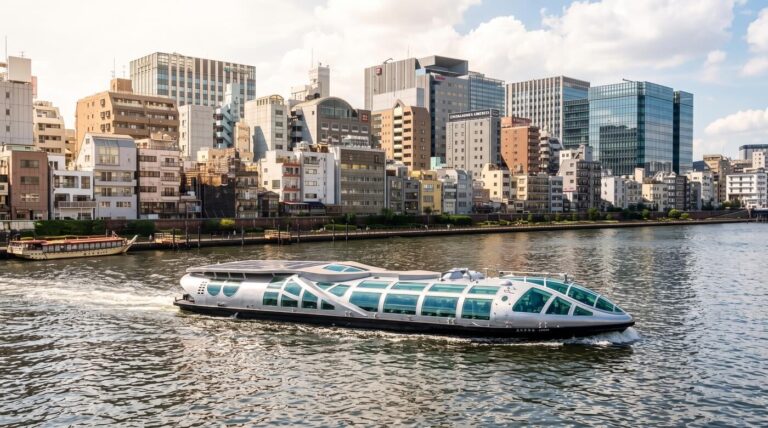
Open-topped catamaran, Japan's first small twin-hull sightseeing boat, flush toilet, backrest seats
Open-boat Nihonbashi loops past Edo Castle walls and Skytree, from ¥1,500
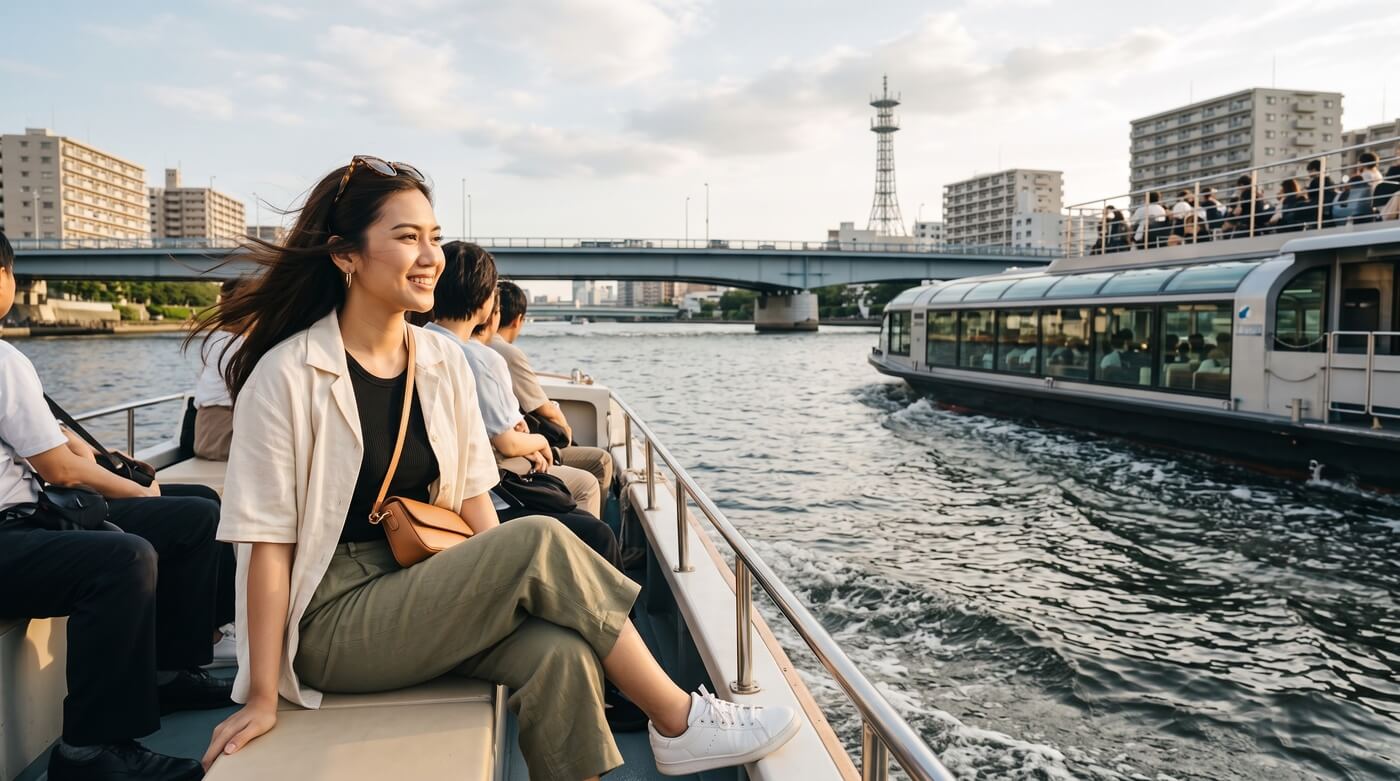
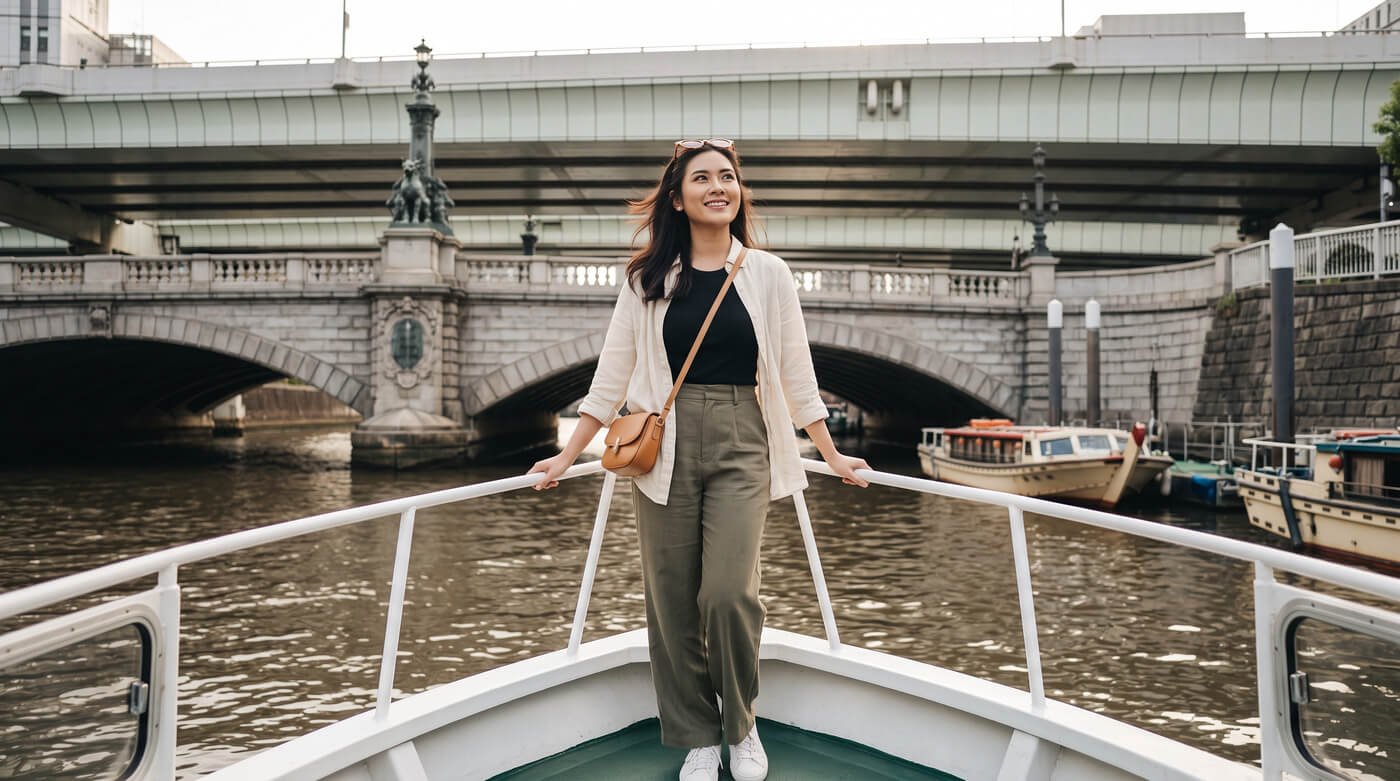

The Nihonbashi River Cruise sets its timetable by the tide, not the clock.
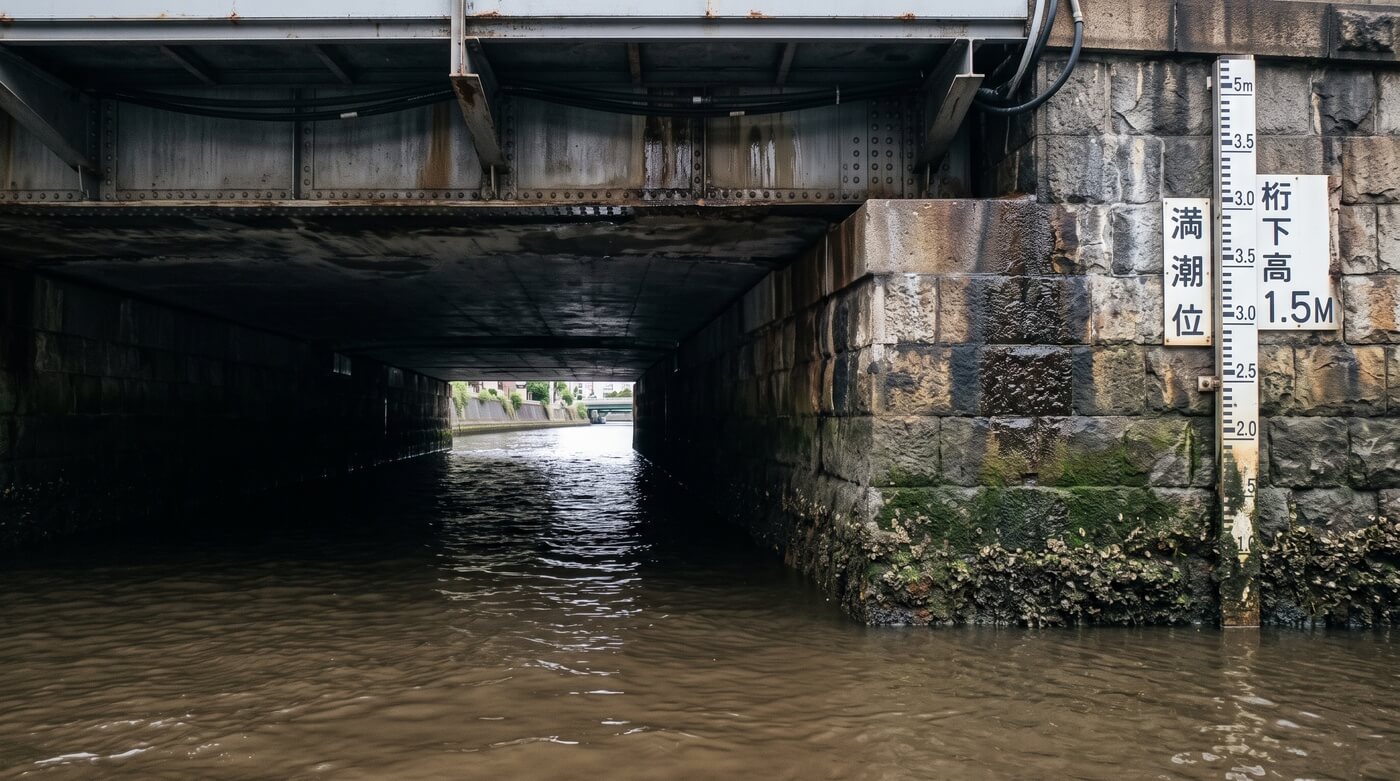
Because the Nihonbashi River is crossed by low bridges that boats cannot clear at high water, with up to a 2m tidal swing, departures slide about 50 minutes later each day and some courses drop off the schedule entirely, which is why Tokyo Bay Cruising (東京湾クルージング) posts a fresh monthly timetable on the 20th.
These are open-topped sightseeing loops from the Nihonbashi Boarding Dock under the historic stone bridge, with a live Japanese guide, and not a meal cruise.
Boats leave and return to the same pier.
Year-round courses run 45, 60, and 90 minutes, threading the Nihonbashi, Kanda, and Sumida rivers past Edo Castle stone walls, Akihabara, and Tokyo Skytree.
The service opened in 2011 and had carried about 450,000 passengers by 2023.
You can bring your own food and drinks.
Most of the fleet has no roof, so rain cancels the sailing.
The Nihonbashi River Cruise costs from ¥1,500 for 45 minutes and is running normally as of September 2026. Low bridges over the Nihonbashi River are impassable at high water, so departures shift roughly 50 minutes later each day and whole courses drop off the schedule without warning. Check the timetable the night before you go.
Nihonbashi River Cruise runs open-boat loops from ¥1,500 past Edo Castle walls and Tokyo Skytree. Fares, tide timing, and rain rules from Tokyo Trip Guide.
Most of what decides whether this cruise works for you is not the fare. It is the tide, the weather policy, and the language of the guide, and all three change what you get for your ¥2,500. Here is what to settle before you book.
Trip Essentials
Tokyo Travel Add-ons
Equip yourself for the ultimate Tokyo adventure with the following add-ons, curated just for you.
Flights to Tokyo
Airport Transfer
ICOCA IC Card
Suica IC Card
Tokyo Tours
Luggage Storage
Travel Insurance
Data Security

Japan eSIM
Japan SIM Card
Pocket WiFi Rental
Japan eSIM
The Nihonbashi River Cruise earns its fare on one sailing in particular: the 90-minute Kanda River course at ¥2,500, which loops the Nihonbashi, Kanda, and Sumida rivers and passes the feudal stone walls of Edo Castle at Tokiwabashi.
The 45-minute course at ¥1,500 is the cheap way in and works well with small children, but it turns for home before the stretch that makes the trip memorable.
Every course was sailing normally when we checked for this Tokyo Trip Guide entry on 5 September 2026.
Two limits are worth knowing before you pay.
The live guiding is in Japanese, and English commentary happens on some sailings rather than reliably, so a fair share of the history goes past you if you do not read the language.
The boats are also open-topped, which means rain cancels the sailing outright, with a refund and no chance to move your booking.
Tokyo Bay Cruising (株式会社東京湾クルージング) has run the service from the Nihonbashi Boarding Dock since 2011 and had carried around 450,000 passengers by 2023.
Boats leave between 10:00 and 17:00 every day except Wednesday, when nothing sails at all.
Tripadvisor rates the operation 4.2.
The sailing begins under concrete and ends in open sky, and knowing that order changes how you feel about the first ten minutes.
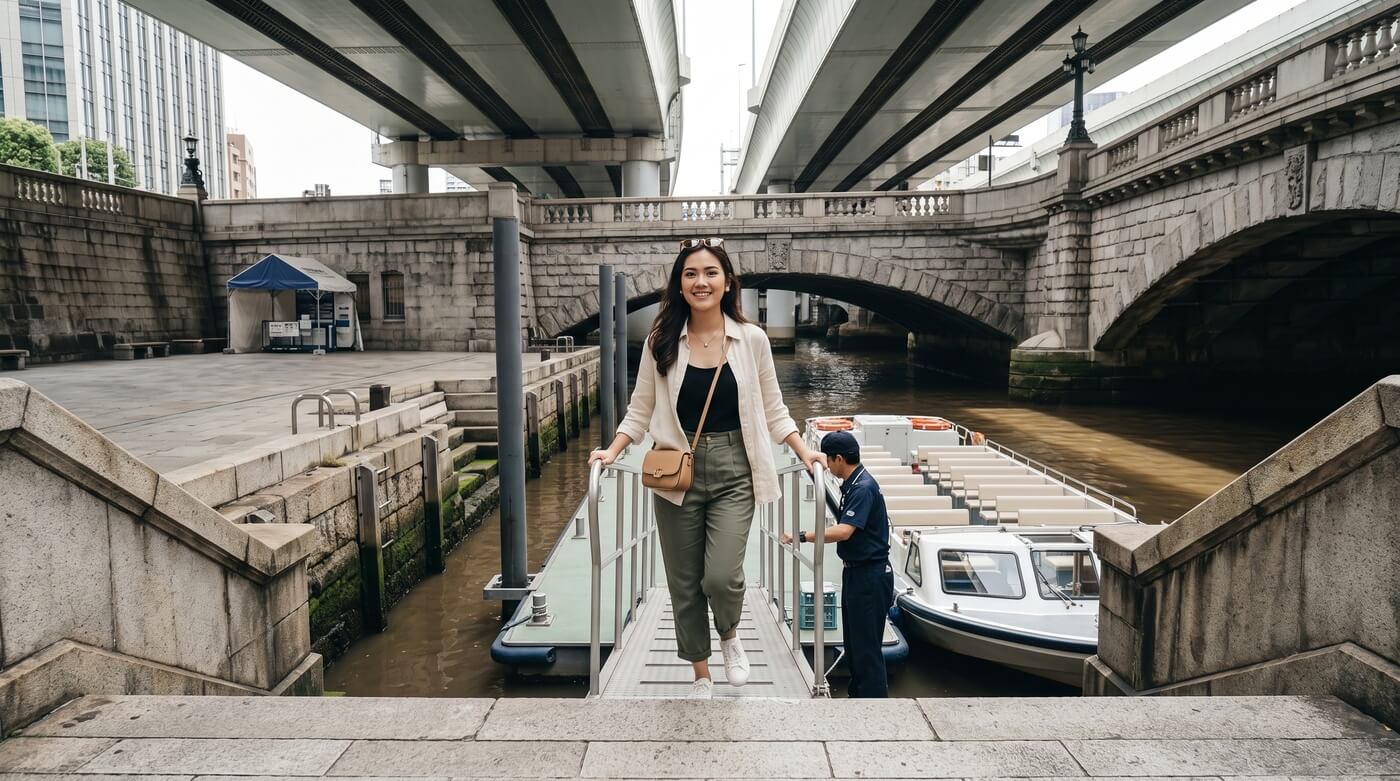
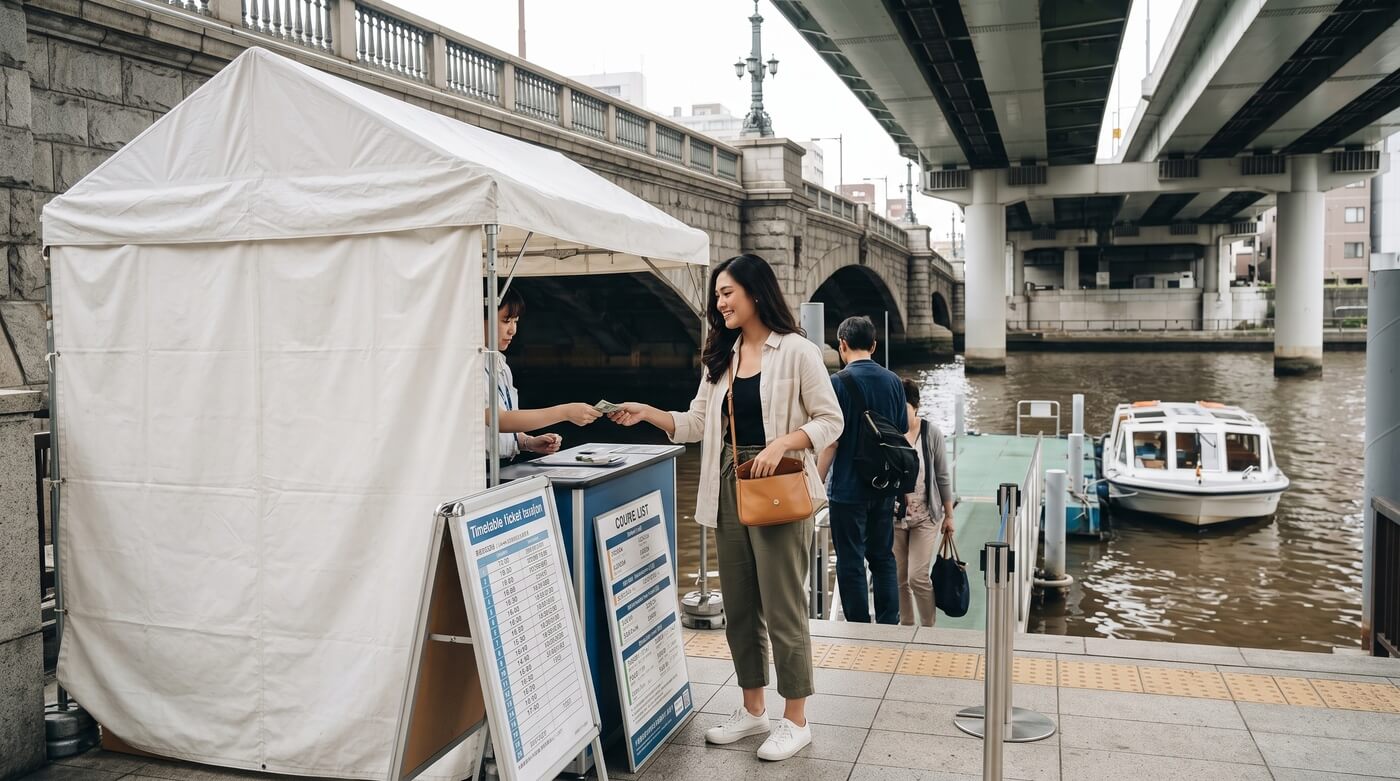
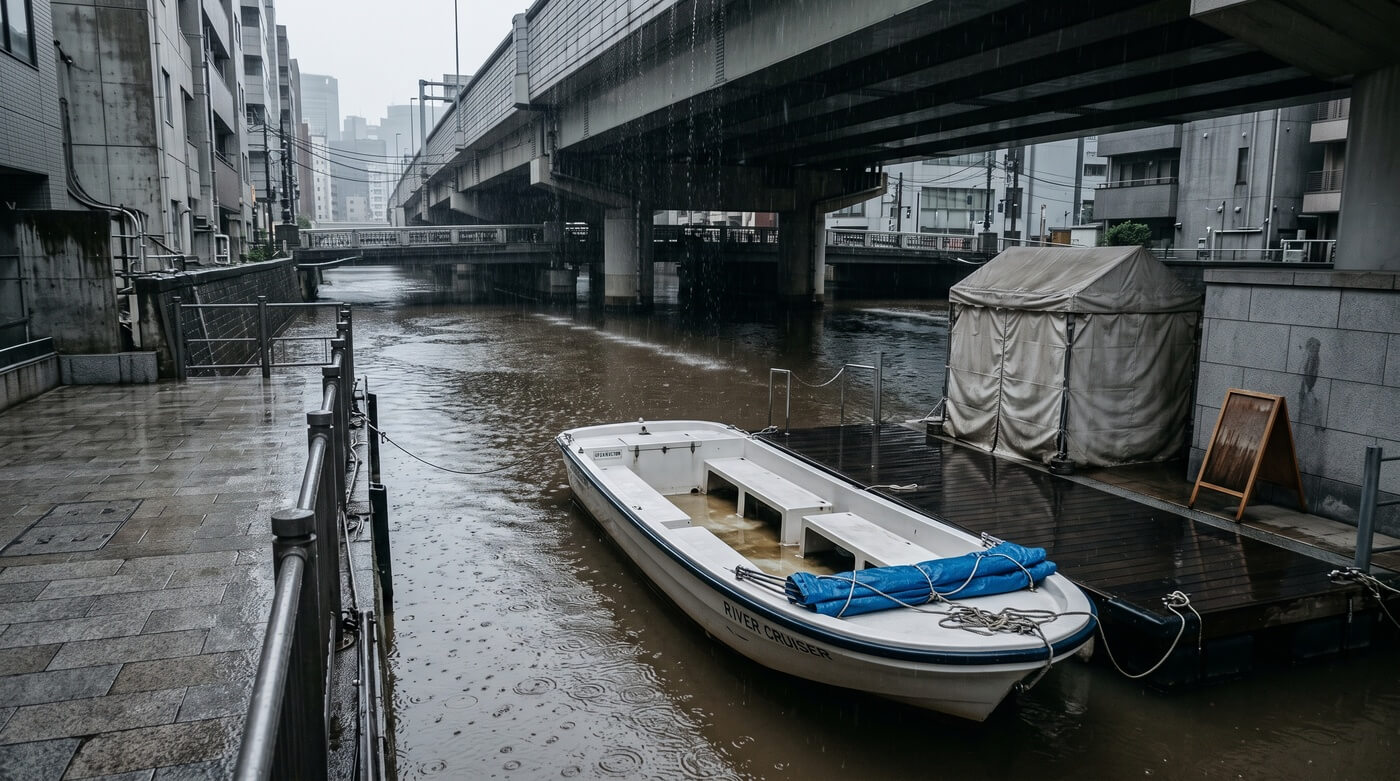
Boarding happens at Taki no Hiroba, the sunken plaza directly beneath the stone Nihonbashi bridge, at a floating pontoon about 20m long with step-free access.
Reception is a tent, and other operators check in beside it, so look for the Nihonbashi Cruise logo rather than the first queue you see.
The boats themselves are small: the SS Nano fleet seats between 26 and 44 people, with backrest seats and a flush toilet on board.
Nothing is served, so a bento or a konbini haul from the shops around Mitsukoshimae is a good idea before you walk down.
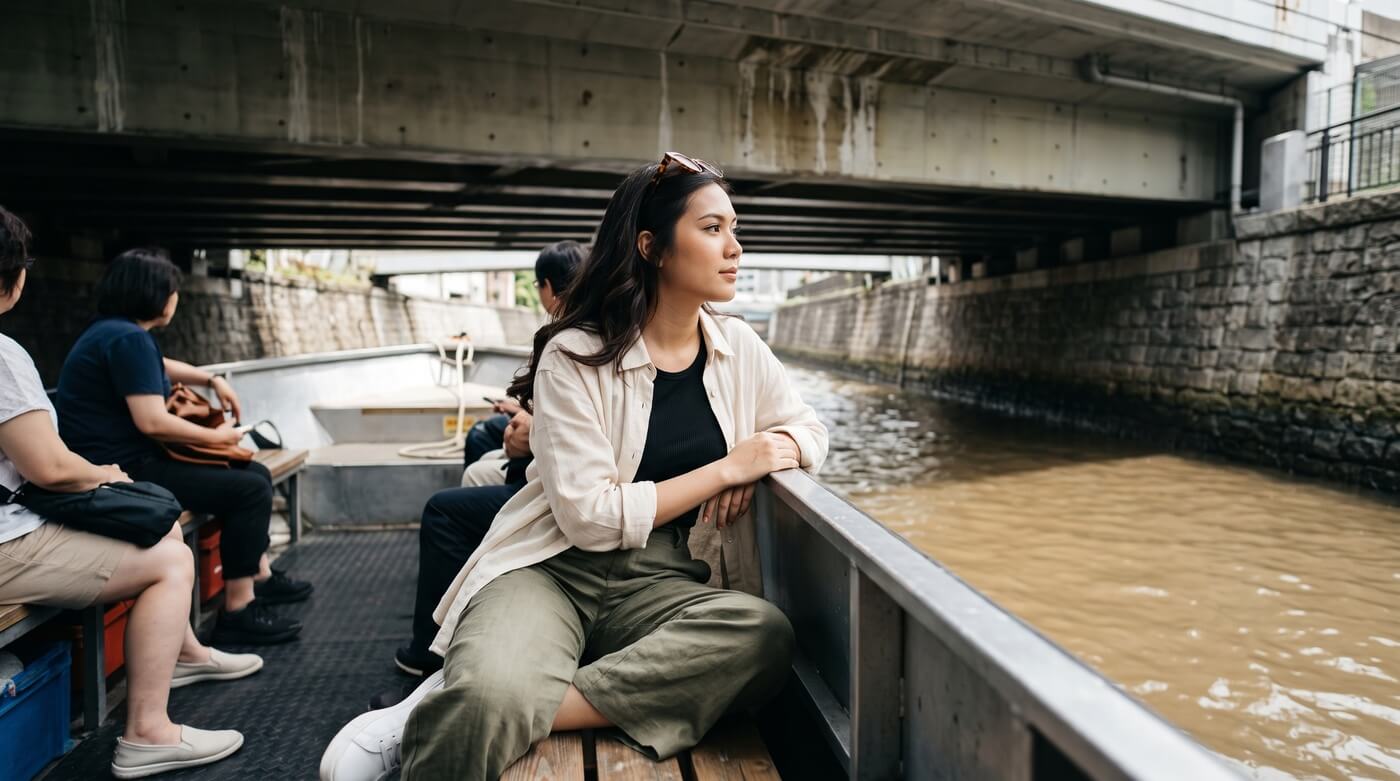
The opening stretch of the Nihonbashi River runs beneath the Shuto Expressway, and it is genuinely gloomy.
The viaduct roofs the water almost end to end here, so instead of a skyline you get pillars, girders, and the underside of a motorway a few metres above your head.
Guides lean into it, because the point is the engineering rather than the view.
That claustrophobia is the reason the rest works.
You pass Edobashi with the traffic thundering overhead, and the guide will usually point out the height clearance markers that dictate whether your boat could have sailed at all two hours earlier.
Tokiwabashi is where the cruise stops being a novelty and starts being a history lesson.
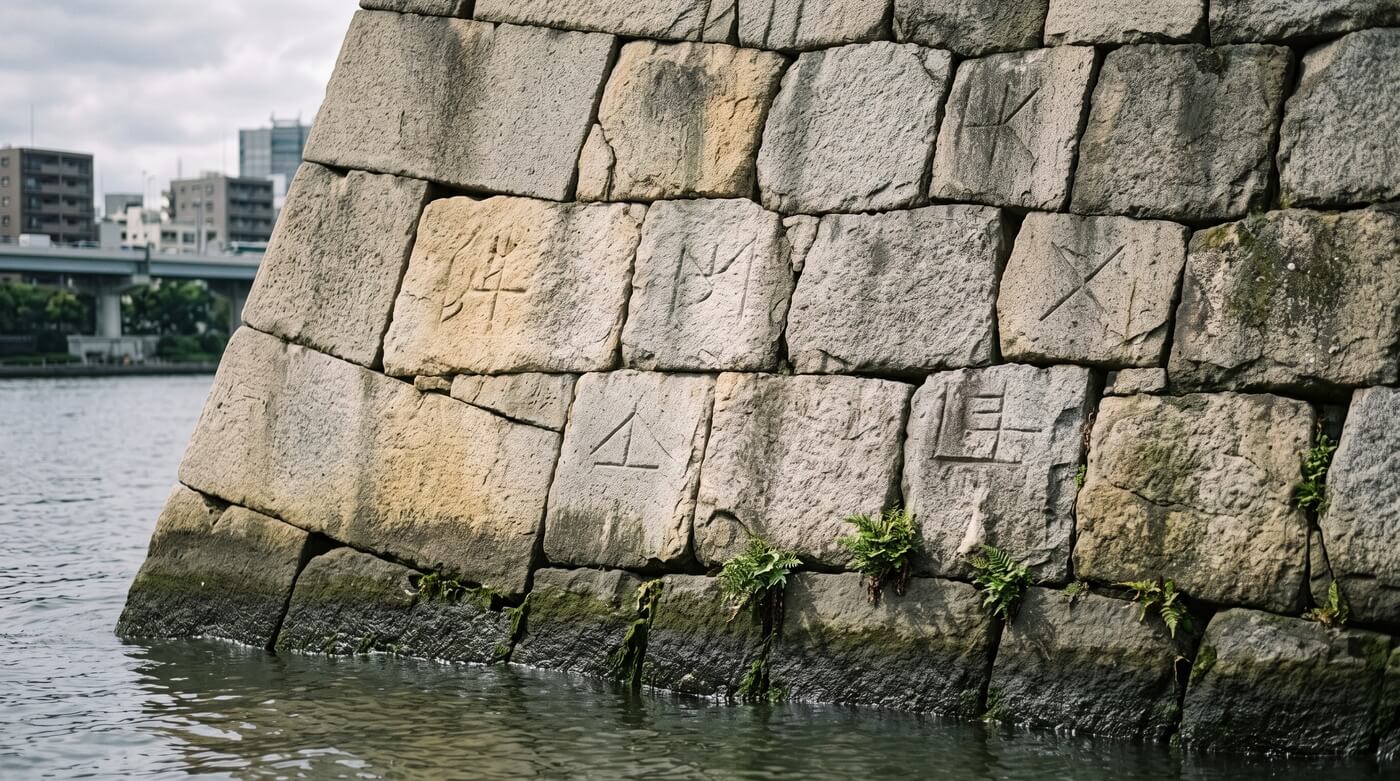
The stone walls here are original Edo Castle masonry, and from water level you sit close enough to read the mason’s marks cut into individual blocks, symbols the feudal domains used to claim credit for the sections they built.
You cannot see any of this from the street above.
The boat then swings into the Kanda River and climbs toward Ochanomizu, through a channel cut through a ridge in the early 1600s to divert the river and protect the castle from flooding.
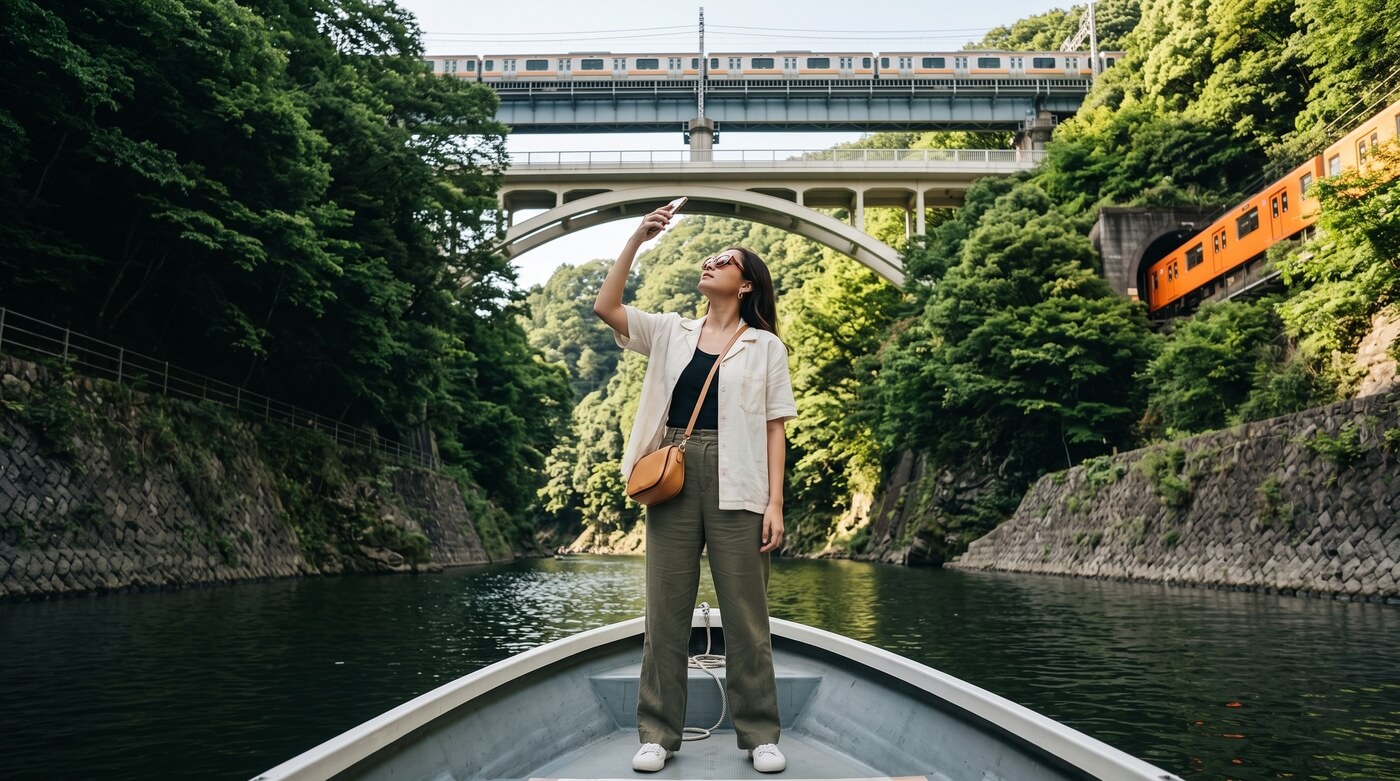
The banks rise into a proper little valley, green and steep, and at the top of it the Hijiribashi arch crosses overhead.
Wait a minute or two and you get the crossing that Tokyo train photographers queue for: a Chuo Line train on the bridge above, a Sobu Line train alongside, and an orange Marunouchi Line carriage emerging from the hillside over the water.
Sit anywhere; the channel is narrow enough that both sides see it.
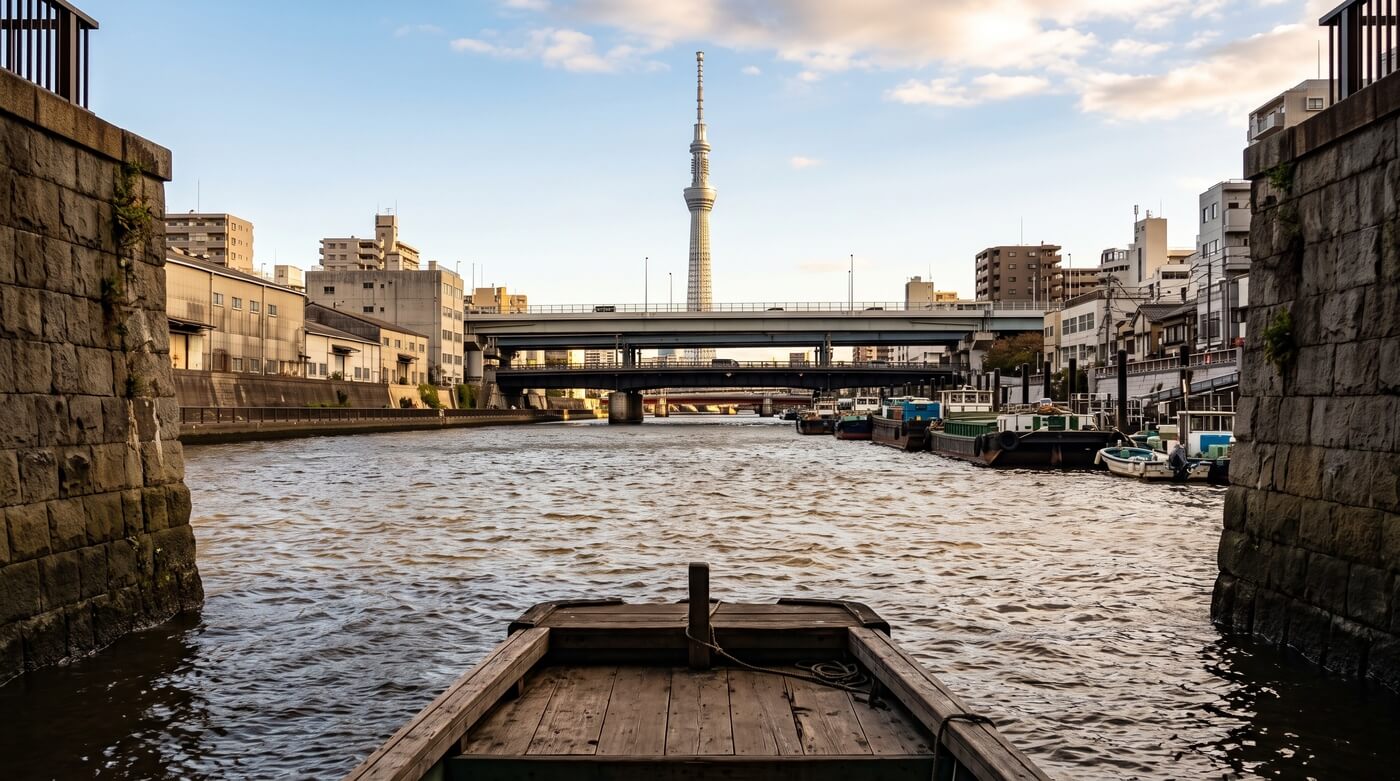
The photograph most people come back with happens in the thirty seconds after the boat clears Yanagibashi and turns onto the Sumida River.
The Kanda spits you out into water four or five times wider, the wind arrives immediately, and Tokyo Skytree stands framed between the banks upstream.
Have the camera up before the turn, because the framing closes within a minute.
Three things surprise first-timers on this stretch.
The bridges are far lower than they look from a bridge deck, and crew will ask you to stay seated at several of them; KKday counts 47 of them on the full Kanda route, which sounds like marketing until you start ducking.
The commentary is loud, because it has to compete with traffic noise bouncing off concrete, so the back rows are quieter if you want to just look.
And the water smells of tide rather than river once you reach the Sumida, a salt and silt note that catches people who assumed they were on freshwater the whole way.
The boat passes directly beneath Akihabara’s electronics district at Mansebashi without you seeing a single shop sign, which is a strange feeling if you walked those streets that morning.
The return leg down the Sumida past Kiyosubashi and Eitaibashi is the calmest part of the trip and the only stretch where you can sit back rather than crane, which is exactly why the 90-minute course does not feel like 90 minutes.
Book the 90-minute Kanda River course, and book it online for a weekday sailing at ¥2,500 rather than paying ¥2,800 walking up at a weekend.
The saving is small, but the online price applies across the range and the same-day desk takes cash or PayPay only, so a card in your pocket is no help at the tent.
An elementary-age child rides the Kanda course for ¥1,000, up to two children per adult.
The 60-minute Oedo TOKYO course at ¥2,000 is the one to skip.
It covers the same water as the 45-minute run at a gentler pace for ¥500 more, which buys you time rather than sights.
Either keep the ¥500 or add another ¥500 and take the Kanda course instead, which goes somewhere the shorter loops do not.
The seasonal Sunset Cruise at ¥4,500 deserves the same scepticism.
Seventy minutes on the same open boat costs nearly double the Kanda fare, and while dusk over the Sumida is lovely, you are paying a large premium for lighting.
The Tokyo Port course is better value at ¥2,200 booked ahead against ¥2,700 on the day, though the Rainbow Bridge views it advertises are distant rather than close.
Reservations are recommended rather than required.
With boats seating 26 to 44, a single popular departure fills fast, and the roofed SS Serenade goes to larger group bookings rather than to whoever asks for it.
In practice that means weekday mornings usually take walk-ups without drama, while weekend afternoons and anything in blossom season should be held online days ahead.
If you are two people and flexible about the hour, turning up at the tent and taking whatever sails next is a reasonable gamble; a family of five on a fixed schedule should not try it.
Tidal range is the reason the Nihonbashi River Cruise cannot publish a fixed daily timetable.
The Nihonbashi River sits under a run of low bridges, the tide moves as much as 2m, and at high water the boats physically cannot pass, so each day’s departures shift about 50 minutes later and some courses vanish from the schedule entirely.
The operator posts the following month’s timetable on the 20th.
Afternoon sailings are the sweet spot for light in the Ochanomizu valley, where the cutting is deep enough to sit in shadow early in the day.
The practical consequence of the sliding timetable is that you cannot plan this cruise more than a few weeks out with any confidence about the hour.
Pick the day first, check the published month, then build the rest of the afternoon around whatever departure exists rather than the other way round.
Cherry blossom season rewrites everything: between 20 March and 12 April 2026 only hanami courses run, and normal courses pause completely from 13 to 16 April.
If sakura is the reason you are booking, treat those dates as the schedule rather than a footnote, and accept that the Kanda course as described here is simply unavailable in that window.
Rain cancels the Nihonbashi River Cruise, and the refund is the only remedy on offer.
The operator states plainly that it does not resume or transfer a cancelled sailing even if the weather clears later the same day, so a cancelled 14:00 departure does not become a 16:00 one.
The call goes up around 08:00 on the official site and on X (@TokyoBay_Cruise), and sometimes the previous afternoon when a front is obvious.
Book the cruise for early in your trip rather than the last afternoon, so a washout leaves you a second attempt.
Winter sailings need a real coat: the Sumida stretch is exposed and the wind on an open deck at river level is colder than the forecast suggests.
Summer has the opposite problem, since there is no shade on the Nano boats, and a 90-minute August afternoon on the water is punishing without a hat and water.
The Tokyo Water Bus is transport that happens to be scenic, and the Nihonbashi River Cruise is the reverse.
The ¥1,180 Asakusa to Hama-rikyu run costs less than half the Kanda course, includes the garden’s ¥300 admission, and deposits you somewhere new.
The Nihonbashi boat returns you to the pier you left, and what you pay for is access to narrow inland channels the water bus never enters.
The Symphony Tokyo Bay cruise answers a different question again.
Boarding starts at ¥1,800, the ships are enclosed, the water is flat, and you can eat a proper meal at a table.
Nothing on the Nihonbashi River Cruise is served, and nothing about it is smooth.
Pick by what you want from the afternoon.
History readers and photographers should take the Kanda River course.
Families with a tight budget and short attention spans should take the water bus to Hama-rikyu.
Couples wanting dinner and a view of the bay should book Symphony and leave the Nihonbashi River for another day.
The best pairing runs the day in reverse order to the boat.
Spend the morning at Kanda Myoujin and the electronics streets below it, then take an afternoon Kanda River sailing and pass underneath everything you just walked.
Recognising a bridge from below that you crossed three hours earlier is the closest this cruise gets to a party trick.
The lazier option keeps you inside Nihonbashi entirely.
Mitsukoshimae Station Exit B6 puts you a minute from the pier, so buy lunch from a department store food hall, eat it on the boat, and walk it off around the bridge afterwards.
Anyone building the trip around water can slot the sailing into a three-day couples plan that already moves by river, swapping the Sumida leg for this one.
Infants under one ride free and need no reservation.
| Route | Vessel | Duration | Adult | Child | Frequency | Notes |
|---|---|---|---|---|---|---|
| Oedo TOKYO Cruise 45 min Editor's pick | SS Nano open boat | 45 min | ¥1,500 | Several daily, tide dependent | Cheapest and shortest loop down the Nihonbashi River into the Sumida, with a Skytree view. Good with young kids. | |
| Kanda River Cruise 90 min Editor's pick | SS Nano open boat | 90 min | ¥2,500 | ¥1,000 | Multiple daily, tide dependent | The signature loop through the Nihonbashi, Kanda, and Sumida rivers past Tokiwabashi, Hijiribashi, Mansebashi, and Yanagibashi, featured on NHK's Buratamori. Advance online ¥2,500 weekday, walk-up ¥2,800 on weekends; elementary-age child ¥1,000, up to two per adult. |
| Oedo TOKYO Cruise 60 min | SS Nano open boat | 60 min | ¥2,000 | Several daily, tide dependent | Adds all the Important Cultural Property bridges of the Sumida River at a slower pace. | |
| Tokyo Port Cruise 70 min (seasonal) | SS Nano open boat | 70 min | ¥2,700 | Seasonal, select days | Runs out to Tokyo Port for distant Rainbow Bridge and skyline views. Advance online fare ¥2,200. | |
| Sunset Cruise 70 min (seasonal) | SS Nano open boat | 70 min | ¥4,500 | Seasonal evenings | Dusk-to-dark sailing toward Harumi or Asakusa. Bring warm layers; the boat is open. |
The views you are actually paying for. Red chips open our full guide to that spot.
Open-topped catamaran, Japan's first small twin-hull sightseeing boat, flush toilet, backrest seats
Open-topped, flush toilet, backrest seats
Open-topped, flush toilet, backrest seats
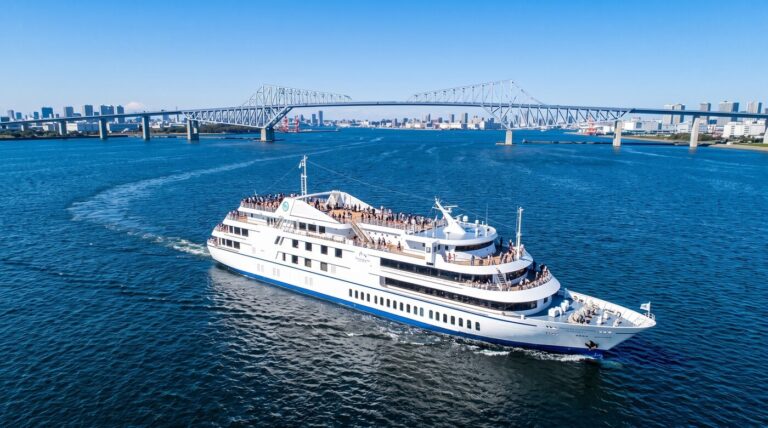
Roofed boat used for larger bookings, flush toilet
1-9 Nihonbashi, Chuo City, Tokyo 103-0027 (on the Nihonbashi River)
Mitsukoshimae Station Exit B6, 1-minute walk; Nihonbashi Station Exit B12, 2-minute walk
Reception is a tent in Taki no Hiroba below the bridge; look for the Nihonbashi Cruise logo, since other operators check in beside it. Floating pontoon, 20m long, step-free.
DirectionsFares and timetable last verified on September 5, 2026. Check the operator's live status before you travel.
First-timers should book the 90-minute Kanda River Cruise, from ¥2,500 for adults. It covers the Nihonbashi, Kanda, and Sumida rivers, passes the Edo Castle stone walls and dozens of historic bridges, and was featured on NHK’s Buratamori. If you have young children or limited time, the 45-minute Oedo TOKYO course from ¥1,500 is the easier choice.
The Nihonbashi River Cruise uses open-topped boats, so rain or a rain forecast cancels the sailing. You get a full refund, but there is no rescheduling or rebooking to another day, even if the weather clears. The operator posts the decision around 8am on the day on its website and on X (@TokyoBay_Cruise), and sometimes flags a likely cancellation the previous afternoon.
The Nihonbashi River Cruise provides a live guide, but the commentary is in Japanese. Booking channels such as KKday list the guide language as Japanese, and some guests report a guide adding English on certain sailings, so English is occasional rather than guaranteed. Non-Japanese speakers still enjoy the views, but expect to miss much of the historical narration.
The Nihonbashi River Cruise is the most central way to see Tokyo from the water, and the 90-minute Kanda River course is the one to book.
You pass directly under the stone Nihonbashi Bridge, read the feudal masons’ marks on the Edo Castle walls, and glide beneath a stack of low bridges (KKday counts 47 on the route) while trains rattle overhead near Akihabara, all with a guide who genuinely knows the river.
Two honest caveats.
The guiding is Japanese; one Tripadvisor guest described a guide who spoke ‘1/2 in Japanese and 1/2 in perfect English,’ but that is guide dependent, not a promise, so a chunk of the history will pass you by.
And the open boats cancel for rain with a refund only, never a reschedule, so a wet forecast can wreck your plan.
Tripadvisor rates it 4.2, and that matches the ride.
Go on a clear afternoon, bring a konbini snack, and dress for wind.