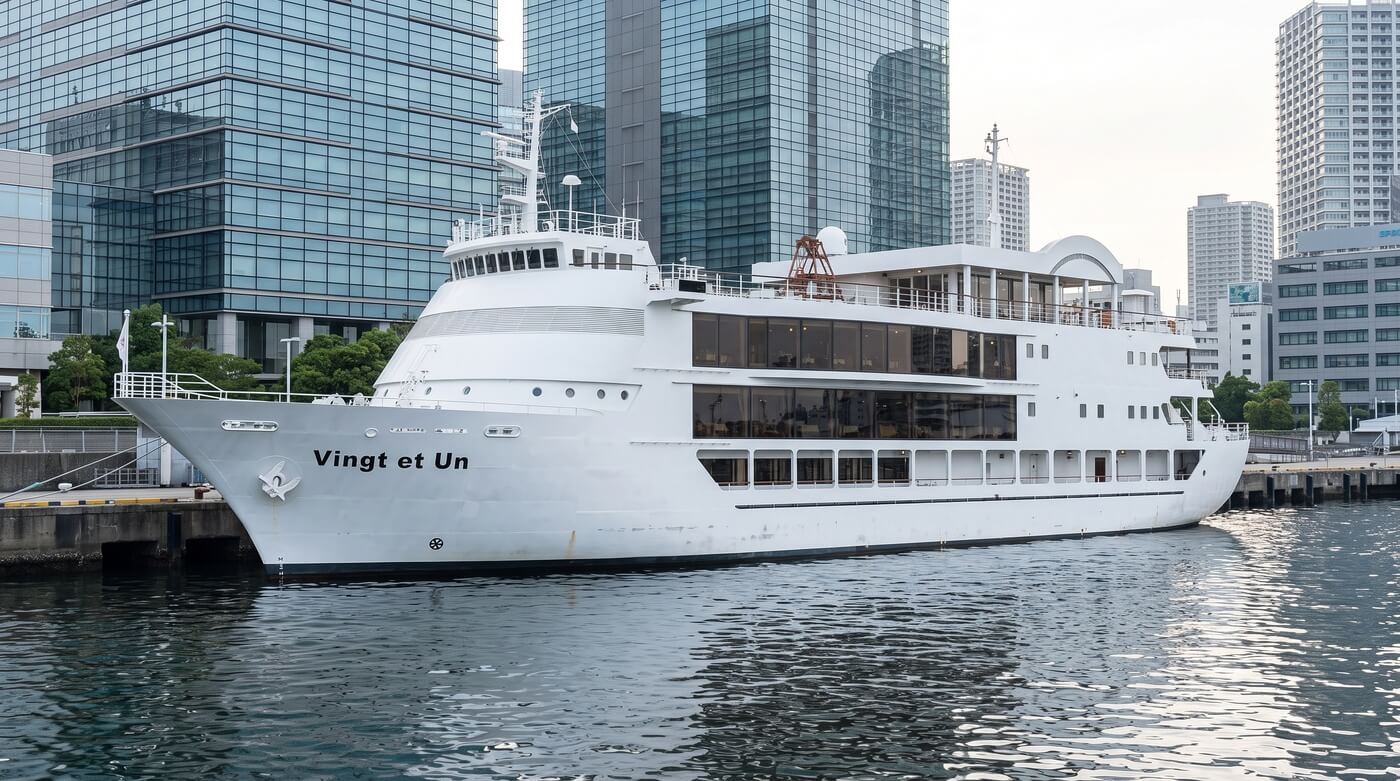
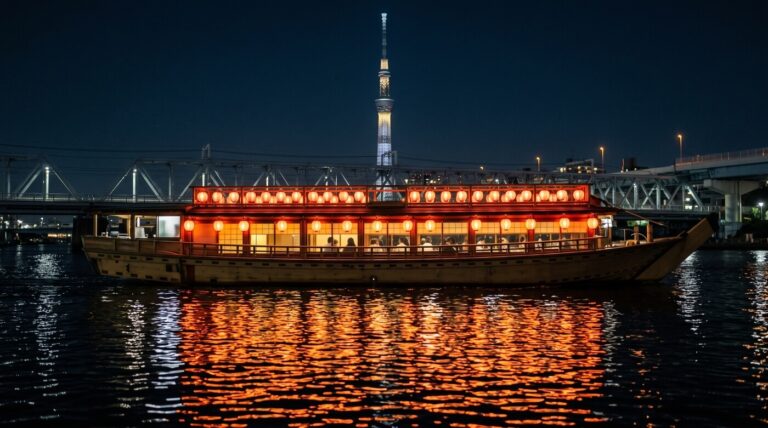
The Tokyo Bay dinner cruise aboard Vingt et Un no longer exists. The restaurant ship stopped carrying passengers in early March 2020, Tokai Kisen closed the business on 30 June 2020, and the vessel left Japan that November. The working replacement sails from Hinode Pier, about 400 metres south of the Takeshiba berth, and boarding starts at ¥1,800.
Vingt et Un: Tokyo Bay Dinner Cruise Ship from Takeshiba – Nothing sails under the Vingt et Un name today, and nothing will.
Checked on 6 September 2026 for this Tokyo Trip Guide entry, the operating company is dissolved, the Takeshiba berth handles island ferries instead of restaurant guests, and the hull itself is registered in Mongolia.
What follows is what the cruise actually was on the water, why live-looking booking pages for it still exist, and which boat to take on the same stretch of bay now.
Key Highlights
Hide
- Status: Discontinued, withdrawn 30 June 2020
- Ship: Vingt et Un, launched 1989, 1,717 gross tons, now flagged in Mongolia as PRINCESS
- Boarding pier: Takeshiba Pier, 1 minute from Takeshiba Station on the Yurikamome
- Book instead: Symphony from Hinode Pier, boarding only from ¥1,800
- Verified: 6 September 2026
Trip Essentials
Tokyo Travel Add-ons
Equip yourself for the ultimate Tokyo adventure with the following add-ons, curated just for you.
Is the Vingt et Un Cruise Still Running?
No. Vingt et Un stopped carrying passengers in early March 2020 and never restarted.
Tokai Kisen’s board voted on 29 May 2020 to leave the restaurant ship business entirely, set a withdrawal date of 30 June 2020, and dissolved its subsidiary Tokyo Vingt et Un Cruise Co., Ltd., citing an ageing hull, rising maintenance costs, sharper competition on the bay, and pandemic losses.
There was a short interlude in between where the ship’s kitchen sold bento boxes from the pier, and then the first state of emergency ended even that.
The ship had run since October 1989 and carried more than three million people across 31 seasons, so the shutdown was not a quiet fade.
The reason the internet has not caught up is that nobody maintains a page for a boat that stopped earning.
Charter agents still publish its deck plans and per-head rates.
Japanese portals still list lunch, twilight, and dinner departures as though you could pick one.
Tripadvisor still shows a 3.9 average from 38 reviews, now flagged permanently closed, and every one of those reviews is dated 2019 or earlier.
Two Hours on the Water From Takeshiba
The Vingt et Un loop ran two hours and covered the working half of Tokyo Bay rather than the postcard half.
Boats left Takeshiba Pier, passed under Rainbow Bridge, ran along Odaiba, turned down the container wharves at Shinagawa and Oi, reached the water off Haneda Airport, and came back the same way.
Boarding set the tone before you moved.
The berth sits beside Tokai Kisen’s island ferry terminal, so you walked past freight pallets bound for the Izu and Ogasawara islands rather than through anything resembling a cruise terminal.
The gangway smelled of harbour water and marine diesel, which was fair warning that this is a working port with a restaurant parked in it.
Ten minutes out, the bridge arrives.
Passing directly beneath Rainbow Bridge is the moment everyone leaves the table for, and it is worth doing from the open deck rather than through glass, because the underside of the span fills the entire sky for roughly forty seconds and no window frames it properly.
That is the photo, and it is better on the way back with the city lit behind it.
Then the scenery turns industrial, and that is the part first-timers do not expect.
The gantry cranes at Oi Container Terminal stand in rows with their booms raised, which is why Japanese passengers call them kirin, giraffes.
Freighters sit at anchor under floodlights.
For a solid twenty minutes in the middle of the sailing there is no neon at all, and if you boarded a Tokyo Bay dinner cruise expecting skyline the whole way, that stretch feels like a detour through a logistics yard.
Haneda pays it back.
Aircraft come down the approach over the water every couple of minutes on a normal evening, low enough to read the livery, and the boat holds under the flight path long enough that you stop counting them.
The turn for home is the best part of the route: Tokyo Tower and Tokyo Skytree line up beyond Rainbow Bridge as you come back under it, with the Shiodome towers stacked behind.
The honest complaint was the seating.
Vingt et Un sold full-price window tables whose actual view was a partition or a curtain, and its own reviewers said so plainly, one describing a birthday lunch spent looking at a blue curtain and vowing to take Symphony next time.
Licensed for 700 but normally carrying 300 to 350, the ship never felt crammed.
It simply meant the good sightlines went to whoever bought the higher meal plan, and English on board was thin by most accounts.
The water has not changed, and the Symphony ships now working the same route out of Hinode Pier cover a longer version of it.
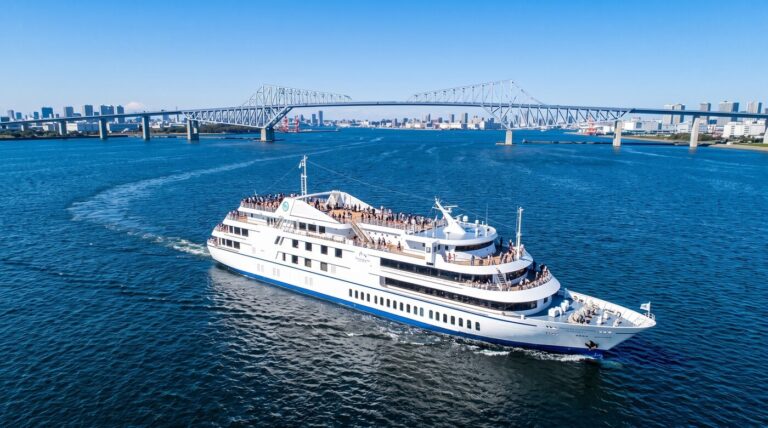
Symphony passes under Rainbow Bridge twice per sailing, adds Tokyo Gate Bridge and a distant read of the Tokyo Disney Resort shoreline, and finishes with the same skyline-behind-the-bridge return.
You lost the ship.
You did not lose the view.
The ¥1,800 Ticket That Replaced a ¥5,300 Lunch
Vingt et Un never sold a deck-only ticket, and that single fact explains why its replacement is better value.
On the operator’s final published tariff, issued in August 2019 for the ship’s 30th anniversary, every fare bundled a meal: lunch and twilight sailings started at ¥5,300 for adults and ¥4,240 for elementary-school children, dinner started at ¥9,500, and the top Prime dinner plan ran ¥15,000, with unlimited drinks a further ¥2,600.
Symphony sells what Vingt et Un would not: boarding only, ¥1,800 for an adult and ¥900 for a child, on the 50-minute afternoon sailing at 15:00-15:50.
No course, no buffet, just the deck, the bridge, and the bay.
That is roughly a third of the cheapest seat the old ship ever offered, for the part of the experience people actually remember.
So the judgement is straightforward as of September 2026.
If the meal is the occasion, book a full Symphony plan and treat it as a restaurant that moves.
If the water is the occasion, buy the boarding-only ticket and spend the ¥3,500 you saved on a proper dinner ashore in Shiodome or Tsukiji afterwards.
Book the Sunset Sailing Over Dinner
Sunset beats dinner on Tokyo Bay, and the reason is the container wharves.
Symphony’s sunset cruise runs 16:20-18:20 and gives you the Oi cranes, the Haneda approach, and the Disney shoreline in daylight, then hands you the skyline switching on during the return leg.
The dinner cruise, 19:00-21:30, gives you two hours of dark water and your own reflection in the glass.
There is one booking trap worth knowing before you commit to a quiet date.
Symphony sets a minimum of 20 passengers per sailing and decides seven days ahead whether a departure runs at all, so midweek afternoons in January and February are the ones that get cancelled.
Weekend slots are safe; a Tuesday in deep winter is not.
If you only want the water and not the meal, the 15:00 afternoon run is the efficient choice, because 50 minutes covers Rainbow Bridge, Odaiba, and Shinagawa without committing your whole evening.
Why Wind and Winter Cancel Bay Sailings
Tokyo Bay cruises are cancelled by weather far more often than by mechanical trouble, and the two windows that matter are typhoon season and midwinter.
Late August through September brings the storms that suspend sailings same-day, which is worth planning around if the cruise is the centrepiece of a fixed date; our typhoon season guide with indoor fallbacks covers what to do with the evening instead.
Winter is the other one, and the problem is not cancellation so much as the deck.
January and February evenings on open water off Odaiba run several degrees colder than the same evening in Shibuya once the boat is making way, and the return under Rainbow Bridge is exactly when you want to be outside.
Bring the layer you would bring for a mountain evening, not a city one.
One date to book early rather than late: Symphony is running a Tokyo Bay Grand Fireworks Festival cruise in 2026, the festival’s first outing in eleven years, and fireworks sailings on this bay sell out well before the general schedule does.
Tokyo Bay Dinner Cruise Options That Still Sail
Three boats now split what Vingt et Un used to do, and the right one depends on why you are going out.
Symphony from Hinode Pier is the direct successor for couples and anniversaries, with four sailings daily and a French kitchen aboard.
Tokai Kisen’s Tokyo Bay Nouryosen still leaves Takeshiba Pier itself each summer, a loop of roughly 1 hour 45 minutes departing around 19:15 at ¥2,000 for adults and ¥500 for elementary-school children, with a discount for anyone who turns up in a yukata on Sunday through Thursday.
Season dates are reset every spring and the run usually finishes in late September.
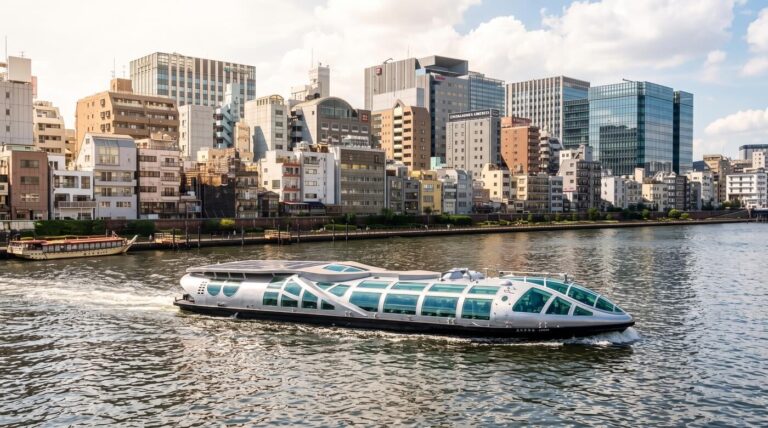
For daylight sightseeing with children, neither is the answer. The Tokyo Water Bus run from Asakusa to Hama-rikyu Gardens
costs ¥1,180 and folds the garden’s ¥300 admission into the ticket, which makes it the cheapest useful hour on the water in this city and the only one of the three that ends somewhere worth walking around.
Put plainly: groups and anyone under 25 should take the Nouryosen in August, couples should take Symphony’s sunset sailing, and families with a spare morning should take the water bus and skip the bay entirely.
Pairing Hinode Pier With Odaiba or Tokyo Tower
Hinode Pier sits one stop from Odaiba on the Yurikamome, which makes the afternoon cruise and an Odaiba evening a single clean move.
Take the 15:00 sailing, get off at 15:50, ride four stops to Daiba or Tokyo Teleport, and you are in Odaiba’s waterfront cluster of malls, arcades, and the Unicorn Gundam before the light goes.
The other pairing runs the opposite way and works better for couples.
Spend the afternoon at Tokyo Tower and the Shiba Park side of Minato, walk twenty minutes downhill to the waterfront, and board the 16:20 sunset sailing so the tower you climbed at three o’clock is the one lighting up beyond Rainbow Bridge at six.
That sequence slots neatly into a three-day plan built around Asakusa, Ginza, and the river if you are stitching a longer trip together.
Give yourself more margin at the pier than you think you need.
Symphony closes check-in 30 minutes before departure on its meal sailings and 15 minutes before on the afternoon cruise, and Hinode Pier is a 12-minute walk from the south exit of JR Hamamatsucho, not the 5 minutes the map suggests.