Tokyo Train Etiquette: The Complete Guide for Tourists




Tokyo Train Etiquette: Ride the Metro Like a Local – Tokyo’s trains carry over 8 million passengers daily through a system built on silence, precision, and mutual respect.
Mastering Tokyo train etiquette means embracing silence, respecting queue lines, and following the golden rule: let passengers exit before boarding.
Switch your phone to manner mode immediately, avoid conversations above a whisper, and position yourself beside doors while riders disembark—never blocking their path.
Queue markings on platforms aren’t suggestions; they’re the choreography that keeps millions moving seamlessly through the world’s busiest metro system.
The unspoken social contract transforms potential chaos into meditative efficiency, and understanding these nuances reveals why Tokyo’s trains operate with such remarkable precision.
Key Highlights
Hide- Maintain silence by switching phones to manner mode and avoiding loud conversations to respect the quiet atmosphere.
- Queue orderly at designated platform markings and wait patiently for passengers to exit before boarding.
- Avoid phone calls on trains; step off at the next station if a call is necessary.
- Always let passengers disembark first by standing aside from doorways to ensure smooth flow.
- Follow cultural norms of consideration and respect to transform commutes into harmonious, efficient experiences.
The Silent Car Culture That Makes Tokyo Trains Unique
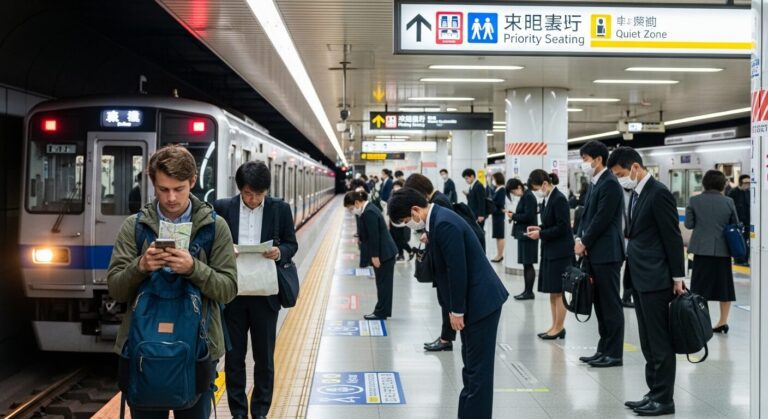
Tokyo’s train cars are remarkably quiet despite holding hundreds of passengers at once.
That near-silence is the result of deeply ingrained cultural norms: phone calls are avoided, conversations stay hushed, and every rider switches their device to “manner mode” before boarding.
The collective result transforms what could be a noisy commute into something closer to a shared meditation space.
First-time visitors often find it surreal, then quickly come to appreciate it.
Tokyo Trip Add-Ons
Equip yourself for the ultimate Tokyo adventure with the following add-ons, curated just for you.








Why Nobody Makes Phone Calls on the Train
Phone calls on Tokyo trains are avoided out of respect for the concept of meiwaku, meaning the act of causing trouble or inconvenience for others.
Loud conversations are seen as selfish intrusions into shared space.
If you receive a call, the accepted practice is to step off at the next station to speak. Texting is always preferred over talking. This norm is not enforced by law or staff, but social pressure makes it near-universal.
- Tokyo Postal Made Easy: Ship Souvenirs and Forward Bags
- Tokyo Happy Hour Guide: Best Drink Deals by Neighborhood
- Tokyo Air Quality Guide: Pollution Levels & Health Tips
- Late Night Transportation in Tokyo: Getting Around After Midnight
- Rainy-Season Rescue: 21 Best Indoor Activities in Tokyo
- Tokyo Electronics Shopping: Akihabara vs. Yodobashi Camera
Manner Mode: Switching Your Phone to Silent
Japanese smartphones come pre-loaded with a “manner mode” setting, a silent vibration profile so culturally embedded that manufacturers named it after proper behavior.
Signs reminding passengers to activate it appear throughout every station and carriage.
Commuters switch to manner mode reflexively the moment they board. Notifications are silenced, vibrations muted.
Nobody is checking your phone, but the collective expectation is clear and consistent.
Get Greater Tokyo Pass
Enjoy unlimited travel on trains, trams, and Toei buses at no extra cost, making sightseeing in the Kanto area both affordable and convenient with considerable savings.
 Buy on Klook
 Buy on Traveloka
The Unspoken Volume Ceiling Everyone Respects
Beyond phone calls, Tokyo trains operate under an invisible volume limit that passengers instinctively honor.
Even whispered conversations can feel conspicuous in a full car.
This is not rigid conformity. It is communal mindfulness that gives everyone a rare pocket of quiet in one of the world’s most stimulating cities.
Commuters naturally lower their voices, rustle bags gently, and adjust headphone volumes without being asked.
Boarding and Exiting: The Rules That Keep Everything Moving
Tokyo’s boarding system runs on a few simple rules that transform potential chaos into seamless flow.
Platform queue markings, door-side positioning, and the golden rule of letting passengers exit first are the foundation of this daily choreography.
Breaking these rules does not just earn disapproving looks. It genuinely slows down a system that moves millions of people on tight schedules.
Let People Off First: The Golden Rule of Tokyo Trains
The single most important Tokyo train etiquette rule is this: always let passengers exit before you board.
Stand beside the doors, not directly in front of them, and wait until the car empties before stepping on.
This is pure efficiency, not just politeness. Boarding before people exit creates a bottleneck that delays everyone.
Seasoned commuters execute this automatically, and you will earn immediate respect by doing the same.
Queue Lines on the Platform
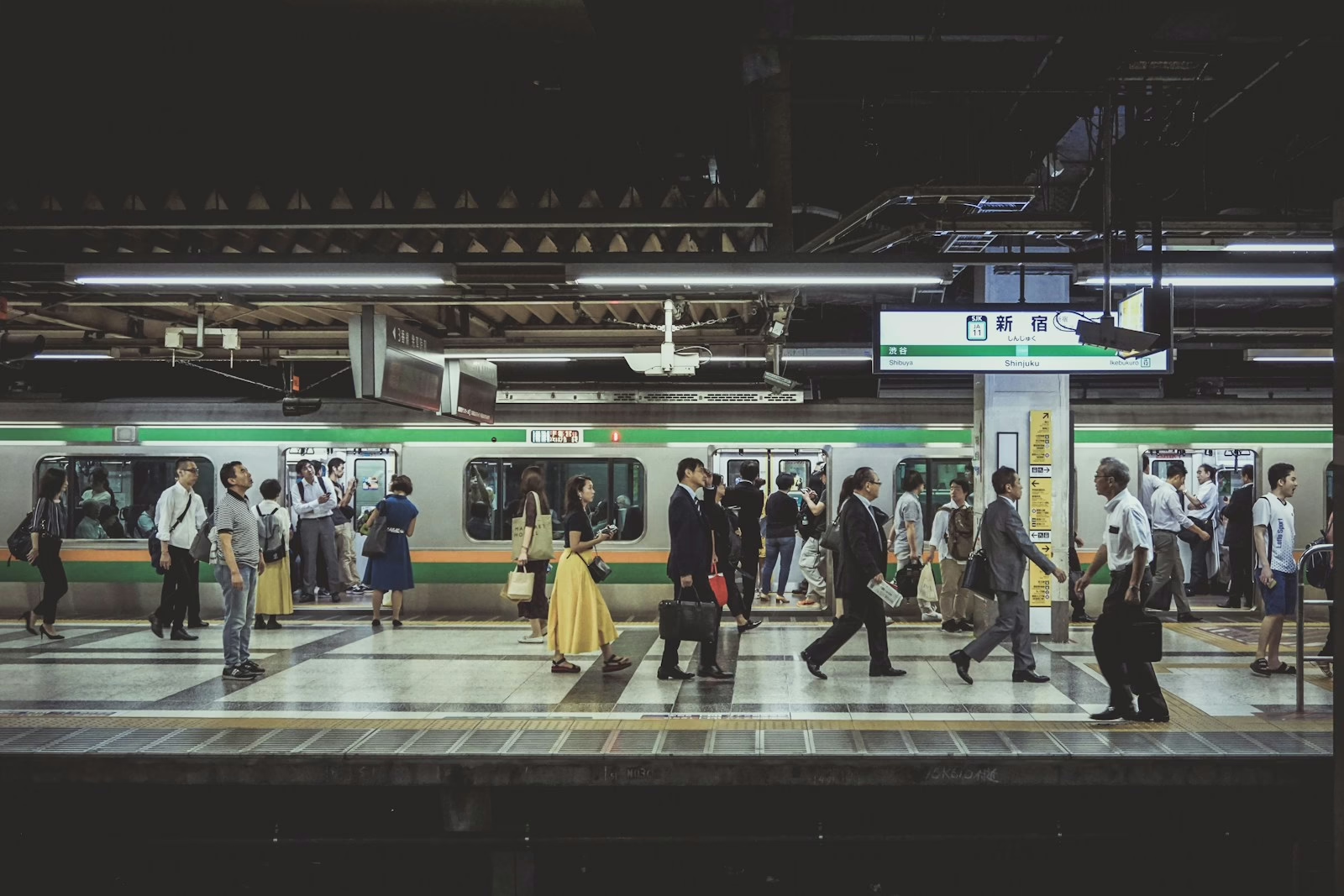
Painted markings on Tokyo station platforms show exactly where to stand while waiting for a train.
These lines are not decorative. They indicate door positions and organize passengers into orderly queues on either side of the doors.
Stand within the marked zones and press toward the platform wall when the train arrives. This creates a clear corridor for exiting passengers. Once the car empties, the queue flows on board in a swift, organized rush.
Which Doors Open at Each Station
Seasoned Tokyo commuters know that the same doors open at the same stations every time.
Platform floor markers, including subtle lines and symbols, show exactly where each door will align when the train stops.
Positioning yourself near the correct door before the train arrives means you board faster and exit more easily.
Tourists who cluster randomly often miss their chance or end up far from the exit staircase.
Spend a few rides observing the patterns and you will crack the code quickly.
Priority Seating: Who Gets the Silver Seats
Tokyo trains feature silver-upholstered priority seats located near the ends of each car.
These seats are reserved for elderly passengers, pregnant women, people with disabilities, and anyone traveling with small children.
Sitting in a priority seat when you are able-bodied is not illegal, but it will earn you noticeable side-eye from locals.
The unwritten rule is to stand if you can, or vacate immediately when someone who needs the seat boards.
Reading the Situation: When Healthy Passengers Can Sit There
Priority seats are not absolute no-go zones during off-peak hours. If the car is half-empty at 2 PM on a Tuesday and no one who needs the seat is present, it is acceptable to sit there temporarily.
The key is staying alert. Keep your eyes up from your phone and be ready to stand the moment an elderly person, pregnant woman, or disabled passenger enters the car.
Think of yourself as temporarily borrowing the spot, not claiming it.
The Subtle Art of Offering Your Seat
Offering a seat in Japan carries more nuance than simply standing up and pointing.
The most effective approach is indirect: stand up and move slightly away from the seat without making a dramatic announcement.
This allows the person to take the seat without feeling pressured to accept charity.
For pregnant women wearing the standard maternity badges distributed by Tokyo Metro, gesture subtly toward the seat and then shift your attention elsewhere.
This respects their autonomy while making your intention clear.
Backpack and Luggage Rules on Crowded Trains
Anything bulky needs to come off your back on a crowded Tokyo train.
Backpacks worn at shoulder height become battering rams that bump and jostle fellow passengers with every sway of the carriage.
The standard practice is to slip your backpack off your shoulders and hold it at knee level or place it on the overhead rack.
This single adjustment frees up significant space and signals that you understand the unwritten rules.
Taking Off Your Backpack and Holding It Low
Slip your backpack straps off your shoulders and cradle the bag at knee level as soon as the car fills up.
This keeps your footprint compact and avoids accidental contact with the people around you.
Watch any seasoned Tokyo commuter and you will see this move executed smoothly the moment they board.
It is one of the clearest signals that someone knows what they are doing on the metro.
Suitcase Positioning During Rush Hour
Large wheeled suitcases present a different challenge. Dragging one onto a packed 8 AM Yamanote Line train will earn serious disapproval from commuters already squeezed into every available centimeter.
The smartest move is to schedule airport trips outside peak hours, which run from 7:30 to 9:30 AM and 5:00 to 8:00 PM on weekdays.
If you must travel with luggage during rush hour, position your bag directly in front of you with wheels planted firmly on the floor.
Corner spots near doors work best, giving you a clear exit path.
For more on navigating Tokyo’s rail options with luggage, the JR Pass vs. Tokyo Metro Pass comparison guide covers which ticket type suits different travel styles.
Overhead Racks and When to Use Them
Overhead racks run above every row of seats and are designed to hold bags during the journey.
Many tourists ignore them and clutch their backpacks instead, which wastes space and creates unnecessary crowding.
Use the overhead rack when the car reaches roughly 70% capacity or higher.
Place your bag with zippers facing upward to prevent spills, and keep valuables in your pockets.
This frees up floor space and demonstrates the kind of spatial awareness that locals notice and appreciate.
Shopping Bags Belong on the Floor, Not on Seats
Placing shopping bags on the seat beside you is one of the most common tourist mistakes on Tokyo trains.
Seats are for passengers, not purchases.
Keep bags planted on the floor between your feet. Stack multiple purchases vertically rather than spreading them across the aisle.
Tuck handles between your ankles to prevent shifting during sudden stops.
This is non-negotiable etiquette that every local follows automatically. If you are heading back from a shopping trip in Harajuku or Ginza, the Tokyo fashion shopping district guide has tips on managing your haul efficiently.
Is Eating and Drinking Allowed on Tokyo Trains?
Eating on Tokyo commuter trains is strongly discouraged and considered poor etiquette.
The unwritten rule applies to virtually all urban metro and JR local lines. Drinking from sealed, spill-proof containers is a gray area that locals navigate with discretion.
The exception is long-distance travel. On the Shinkansen and other JR long-haul lines, eating is not only accepted but actively encouraged through the sale of regional ekiben (train lunch boxes) on platforms.
Why Food Belongs Outside the Train
The no-eating norm protects everyone in a shared, enclosed space. Crumbs land on pressed business suits.
Pungent aromas from hot food fill a car with no ventilation escape. Sticky fingers transfer to shared handrails.
Station platforms and designated eating areas exist precisely for this reason.
Locals embrace the habit of stopping to eat before boarding, then continuing their journey. It is a small adjustment that makes a significant difference to everyone around you.
Shinkansen and Long-Distance Line Exceptions
The Shinkansen operates under entirely different food norms. Passengers open bento boxes, crack open canned drinks, and enjoy full meals during the journey.
This is expected and part of the travel experience.
Station platforms at Shinkansen stops sell specialty ekiben designed specifically for onboard consumption.
Regional delicacies wrapped in beautiful packaging are a highlight of long-distance rail travel in Japan.
Even here, strong-smelling foods can draw disapproving glances, so choose your meal with some consideration for neighbors.
Beverages on Urban Trains: The Gray Area
Sealed beverages occupy an ambiguous space on Tokyo commuter trains. You will spot commuters holding canned coffee or water bottles, but nobody is eating sandwiches or slurping noodles.
The practical guideline is this: sealed containers signal preparation and respect.
Quick, discreet sips during off-peak hours are generally tolerated.
Strong-smelling drinks and anything that requires unwrapping or produces noise draw disapproving glances. When in doubt, wait until you reach your destination.
Rush Hour Survival Guide: Peak Commute Times in Tokyo
Tokyo rush hour runs from 7:30 to 9:30 AM and 5:00 to 8:00 PM on weekdays.
During these windows, trains on major lines like the Yamanote and Chuo reach 180 to 200% capacity, meaning passengers are physically pressed against one another with no room to move.
Planning your sightseeing around these windows is one of the smartest moves a visitor can make.
Trains between 10 AM and 4 PM are dramatically more comfortable and give you a far better experience of the network.
Morning Rush: 7:30 AM to 9:30 AM
The morning peak is the most intense commute period in Tokyo. White-gloved station attendants at major hubs like Shinjuku and Shibuya physically assist passengers into cars to ensure doors close on schedule.
If you must travel during this window, position yourself near the doors if you are exiting within three stops.
Fold your map away, hold your bag low, and move with the crowd rather than against it. Resistance is genuinely futile during the morning crush.
Evening Rush: 5:00 PM to 8:00 PM
The evening peak differs from the morning in atmosphere. Commuters are exhausted, creating a quieter, more subdued energy compared to the caffeinated chaos of the morning. Trains are equally packed but noticeably more subdued.
If your schedule allows, shift your departure to 8:30 PM or later. The difference in comfort is remarkable.
Seats become available, breathing room returns, and the journey becomes genuinely pleasant rather than a test of endurance.
Women-Only Cars During Peak Hours
Women-only cars operate on most Tokyo train lines during weekday morning rush hours, roughly 7:30 to 9:30 AM.
Some lines extend the restriction to evening peak hours as well. Each railway company sets its own schedule, so check the posted signs at your station.
These cars are marked with pink signs on the platform floor and pink stickers on the train car windows.
They exist to provide a harassment-free space during the city’s most crowded commute periods.
Men who board these cars by mistake are expected to move to the next car at the following station without incident.
Personal Space and Body Positioning in Packed Cars
When trains reach sardine-level capacity, how you position your body matters as much as where you stand.
Angling your shoulders sideways, keeping your arms close, and gripping overhead rails rather than letting your hands drift freely are all part of the unspoken code.
These micro-adjustments are what separate a tolerable rush-hour journey from an uncomfortable one for everyone in the car.
Facing the Door or Standing Sideways: Strategic Positioning
Near the doors, stand perpendicular to the opening so you can exit quickly without shuffling.
In the middle of the car, angle your shoulders sideways to minimize your footprint and create breathing room for the people around you.
Plant your feet shoulder-width apart for stability during braking.
If you are carrying a backpack, hold it against your chest rather than wearing it on your back.
These adjustments give you control over your personal space even when the car is completely full.
Where to Place Your Hands in a Crowded Car
Grip an overhead strap or pole whenever one is available. This keeps your hands visible and in a clearly neutral position, which matters in extremely crowded conditions.
When no handhold exists, clasp your hands together at chest level or rest them on your bag.
Never let your arms dangle freely near other passengers.
Keep your phone held directly in front of your face rather than at an angle that pushes your elbows outward.
Hand placement is taken seriously on Tokyo trains, and getting it right protects everyone’s dignity.
The Oshiya: Station Pushers at Major Hubs
At major stations during peak hours, white-gloved station staff known as oshiya (pushers) assist passengers into overcrowded cars.
They position themselves at door openings, read crowd density with practiced eyes, and apply even, distributed pressure across passengers’ backs and shoulders.
Their white gloves signal both safety protocols and an official role that commands immediate respect from commuters.
Watching them coordinate multiple doors simultaneously in the final seconds before departure is one of Tokyo’s most memorable transit experiences.
Sleeping on Tokyo Trains: The Collective Care System
Dozing commuters are a normal and accepted part of Tokyo train culture.
Passengers nod off with the confidence of someone sleeping in their own living room, and fellow riders instinctively accommodate them rather than judge them.
This collective care system reflects a deep cultural trust. Exhaustion is understood as a shared condition, and the train is treated as a safe space to recover from it.
Why Locals Let Tired Commuters Sleep
Sleeping on a Tokyo train is a sign of trust in the community around you, not a sign of carelessness.
Fellow passengers watch over sleepers informally, shifting to support a listing head, monitoring belongings, and occasionally tapping a shoulder when a station approaches.
This guardian mentality operates wordlessly and seamlessly. Nobody assigns themselves the role.
It simply happens as a natural extension of the mutual consideration that defines Tokyo train culture.
What Happens When Someone Misses Their Stop
Even experienced commuters occasionally sleep through their station.
When this happens, conductors gently rouse passengers at terminal stations, speaking quietly to preserve dignity.
Fellow commuters sometimes tap a shoulder with an apologetic bow when they notice someone has clearly gone too far.
On certain lines, station staff offer free return tickets for passengers who overshoot due to sleep.
There is no shame attached to missing a stop. The system handles it with characteristic Tokyo compassion.
Screen and Entertainment Etiquette on Tokyo Trains
Tokyo commuters consume enormous amounts of digital content during their daily rides.
Manga, mobile games, streaming video, and social media scrolling are all common.
The strict rule is that all of it must be silent.
No sound should leak from headphones. Videos must be watched with the volume off or with subtitles.
Gaming audio must be muted completely. Your entertainment is your own business, and keeping it that way is the expectation.
Headphone Leakage and Volume Control
Headphone leakage is one of the most common and most noticed etiquette violations on Tokyo trains.
The enclosed space amplifies tinny, bass-heavy sound in a way that is immediately obvious to everyone nearby.
Before boarding, cup your hand over your earbuds. If you can hear anything from outside, the volume is too high.
Invest in headphones that contain sound effectively rather than broadcasting it. Heavy bass and high frequencies leak worst, so pay particular attention to those ranges.
Watching Videos Without Sound
Watching videos with the sound off or with subtitles is the standard practice on Tokyo commuter trains.
Many streaming apps offer subtitle customization, including font size adjustments that help with readability when you are holding your phone at an awkward angle in a crowded car.
Pre-download content with captions before your journey so you are not dependent on a data connection.
This approach lets you enjoy shows and clips without disturbing anyone around you.
Photography and Selfies on Trains
Taking a selfie against a window backdrop is generally acceptable on Tokyo trains.
Pointing your camera at fellow passengers, even accidentally capturing them in the background, crosses a serious boundary in a privacy-conscious culture.
Empty platforms during off-peak hours offer the best opportunities for photography.
Train interiors make fascinating subjects when passenger-free.
Never photograph strangers without explicit consent, regardless of how visually compelling the scene appears.
For guidance on photography etiquette across the city, the Tokyo photo spots and Instagram tips guide covers what is and is not acceptable in public spaces.
Grooming on Tokyo Trains: What to Save for Later
Personal grooming on Tokyo trains is considered deeply inconsiderate.
Applying makeup, brushing hair, clipping nails, and even blowing your nose loudly all fall into the category of private activities that should wait until you reach your destination.
The golden rule is simple: if the activity involves primping, preening, or producing any kind of bodily debris, save it for a restroom or your accommodation.
No Makeup Application on Moving Trains
Applying makeup on a Tokyo train draws disapproving glances from locals who view the behavior as both inconsiderate and surprisingly intimate for a public space. Beyond the cultural dimension, mascara wands near eyes during sudden stops present a genuine safety concern.
Japanese commuters complete beauty routines before leaving home or use station restrooms.
Powder clouds drifting onto dark business suits, lipstick application during sharp curves, and full vanity setups during rush hour are all behaviors that mark you immediately as someone unfamiliar with local norms.
Hair, Nails, and Other Grooming No-Nos
Hair brushing and nail clipping cross from merely inconsiderate into genuinely unhygienic territory. Nail clippings bounce across the floor. Stray hairs drift onto neighboring passengers. The sound of clippers echoes through a quiet car.
Quick, incidental grooming, such as discreetly tucking a loose strand back into place, is fine.
Anything requiring tools or creating debris is absolutely taboo. Wait until you reach your destination. The freedom to groom properly belongs in private spaces.
Blowing Your Nose: A Surprisingly Serious Issue
Blowing your nose in public ranks among Japan’s most significant social violations.
The sound itself makes many locals visibly uncomfortable, and doing it on a train amplifies the reaction considerably.
If your sinuses stage a rebellion mid-commute, the preferred approach is to sniffle quietly or dab gently with a handkerchief while turning toward the window.
Step off at the next station to handle the situation properly in a restroom if needed.
Pocket tissues distributed by street promoters outside stations are useful to keep on hand for emergencies.
Navigating Tokyo’s Train Lines, Colors, and Transfers
Tokyo’s rail network consists of 13 Tokyo Metro lines, multiple JR lines, and several private railways, all color-coded for navigation.
Once you understand the color system, moving through the city becomes straightforward even without reading Japanese.
The key is learning to follow colors and platform numbers rather than trying to memorize station names in kanji.
The JR Yamanote Line: Tokyo’s Green Loop
The Yamanote Line forms a 21.4-mile loop around central Tokyo, connecting 30 major stations including Shibuya, Shinjuku, Harajuku, Akihabara, and Ueno.
The line is identified by its distinctive green color on every map and signage system throughout the network.
A complete loop takes approximately 60 minutes.
The Yamanote Line serves as the backbone of most tourist itineraries because it connects so many major neighborhoods and interchange points. Trains run every 2 to 4 minutes during peak hours.
Tokyo Metro Lines and Their Color Codes
The Tokyo Metro operates 13 lines, each with a distinct color used consistently across maps, platform signs, and train car markings.
The Ginza Line is orange, the Marunouchi Line is red, the Hibiya Line is silver-gray, and the Chiyoda Line is green.
Bilingual signs in Japanese and English appear at every station, matching platform numbers to line colors.
Following colors is faster and more reliable than attempting to read kanji station names, especially during your first few days in the city.
Transfer Stations and Connection Strategies
Major transfer stations like Shinjuku, Shibuya, and Ikebukuro connect multiple lines across different railway operators.
Overhead signs display both line colors and platform numbers, creating a visual trail through even the most labyrinthine corridors.
Allow extra time for your first few transfers at large stations. Shinjuku Station, the world’s busiest, has over 200 exits and connects more than a dozen lines. Arriving a few minutes early removes the stress of potentially missing a connection while you decode the signage.
IC Card Tap Etiquette and Gate Flow
Suica and Pasmo IC cards are the standard payment method for Tokyo’s trains. Every gate features a blue-lit card reader at hip height on the right side. A quick one-second hover of your card while maintaining a brisk walking pace is all that is required.
Mastering smooth gate flow keeps the constant stream of passengers moving and marks you as someone who knows what they are doing. For a complete guide to loading and managing your card balance, the Suica card top-up guide covers every method available to tourists.
Walking While Tapping Without Breaking Stride
Hold your IC card in your dominant hand at waist height as you approach the gate. Tap when you are roughly one step away, maintaining your walking pace so the barrier opens exactly when you reach it.
The awkward shuffle-stop that many tourists perform creates bottlenecks at busy gates. Watch any experienced Tokyoite approach a gate and you will see a single, fluid motion with no hesitation. Practice this rhythm and your fellow commuters will silently appreciate it.
What to Do When Your Card Balance Is Too Low
When your IC card is rejected at the gate, a beep-beep-beep sound triggers and the barrier closes. This happens to locals regularly and is handled quickly and without drama.
Step aside immediately to the fare adjustment machine located near the gates. Insert your card, and the machine displays your balance shortage in yen. Feed in cash, retrieve your recharged card, and tap through. The entire process takes under 60 seconds. Staff barely glance up during these transactions.
Platform Behavior Before Your Train Arrives
Platform etiquette begins the moment you step off the escalator.
The yellow safety line running parallel to the tracks is a firm boundary, not a suggestion.
Standing behind it is non-negotiable, and platform attendants will remind distracted visitors to step back.
Painted floor markings show exactly where doors will open, allowing you to queue in the correct position before the train arrives.
Standing Behind the Yellow Safety Line
Every Tokyo train platform features a bright yellow line running parallel to the tracks.
All passengers stand behind this line while waiting, regardless of how crowded the platform becomes.
The line protects passengers from wind gusts and the physical danger of passing trains.
Electronic sensors detect when someone crosses the boundary and trigger immediate warnings. Joining the queue several feet behind the line is standard practice, and platform attendants patrol actively during peak hours.
Making Room for Exiting Passengers at the Doors
When train doors open, passengers inside flow outward while those on the platform press themselves against the platform walls.
This creates clear exit lanes that prevent the shuffle-and-squeeze chaos common in other transit systems.
Painted floor markings show exactly where to stand to maximize this exit corridor.
Once departing riders clear the doorway, usually within a few seconds, the platform queue flows on board smoothly.
This sidestep maneuver is one of the most visible and important elements of Tokyo train etiquette.
Last Train Times and Missing the Final Departure
Tokyo’s last trains, known as shuuden, typically depart between 11:30 PM and 12:30 AM depending on the line and station.
Missing the final train means an expensive taxi ride, a night in a manga cafe, or waiting until trains resume around 5:00 AM.
Download the Tokyo Metro or Hyperdia app and check the last departure time for your specific station before heading out for the evening.
Late-night transportation options exist but are significantly more expensive and less convenient.
The Tokyo late-night transportation guide covers all your options if you do miss the final train.
For a broader look at navigating Tokyo’s general etiquette beyond the trains, the Tokyo etiquette guide for first-time visitors is an excellent companion resource.
Wrapping Up
Tokyo train etiquette is not a list of arbitrary restrictions. It is the operating system of a transit network that moves millions of people with extraordinary efficiency every single day. Silence, spatial awareness, and consideration for others are the three pillars that hold the whole system together.
Follow these unwritten rules and you will not just avoid awkward moments. You will move through Tokyo’s metro with the quiet confidence of someone who genuinely understands the city.
Frequently Asked Questions (FAQs)
Can tourists use the Tokyo train system without speaking Japanese?
Yes. All major Tokyo train stations display bilingual signs in Japanese and English, including platform numbers, line names, and exit directions. IC card machines like Suica and Pasmo offer English-language menus.
The color-coded line system means you can navigate effectively by following colors and numbers alone.
How much does a single Tokyo train ride cost?
Fares on Tokyo Metro start at 180 yen for short journeys and increase with distance. JR local line fares start at 150 yen.
A Suica or Pasmo IC card automatically deducts the correct fare at the gate, so you never need to calculate the exact amount in advance.
Is it safe to use Tokyo trains late at night?
Tokyo trains are extremely safe at all hours. Crime on the network is very low, and stations are well-lit and staffed.
The main risk of late-night travel is missing the last train rather than any safety concern.
Trains stop running between roughly 12:30 AM and 5:00 AM on most lines.
Do I need to validate my ticket before boarding in Tokyo?
No separate validation step is required.
Simply tap your IC card on the reader at the entry gate and again at the exit gate.
The system calculates and deducts the correct fare automatically.
Paper tickets purchased from vending machines are inserted into the gate slot rather than tapped.
Are there any train lines in Tokyo that are free to ride?
Several free shuttle services operate in Tokyo, including the Tokyo Waterfront Area Rapid Transit Yurikamome and certain department store shuttles.
The Tokyo Metropolitan Government also operates some free bus routes. However, the main metro and JR lines all require a paid fare or IC card balance.
What should I do if I feel unwell on a Tokyo train?
Press the emergency intercom button located near the doors in every car. Staff will respond immediately.
If you feel faint, sit on the floor rather than blocking the aisle, and alert a nearby passenger.
Most major stations have first aid facilities and staff trained to assist.
The Tokyo healthcare guide for travelers covers what to do in more serious medical situations.
Is it acceptable to eat snacks on the Tokyo Metro during off-peak hours?
No. The no-eating norm applies to Tokyo Metro and JR commuter lines at all hours, not just during rush hour.
Even during quiet midday periods, eating on these trains is considered poor etiquette.
The exception is the Shinkansen and other long-distance JR lines, where eating is fully accepted and even encouraged through the sale of platform ekiben.